Calling copyright infringement stealing is like calling killing a video game character “capital murder.”
Propaganda works, folks.
Calling copyright infringement stealing is like calling killing a video game character “capital murder.”
Propaganda works, folks.
If I didn’t love a lot of the work that comes with IT, there’s no way I could do it.
Let’s face it, reviewing the procedure that EIGRP uses for “deciding” how to route traffic in a network is pretty boring. As is a lot of the rest of IT.
I’m renewing some of my old and expired certs and that’s just part of the process. Has to be done.
But it’s cool building new things when you get the chance to. Not many people realize it but when you build a new network and server architecture and all the associated other bits of infrastructure to go with it, if it’s more complicated than just a few devices you’re often creating something that no one has ever built before in just that way.
It might not be glamorous and if it works well no one even notices, but what you’ve built is most likely unique in the world.
That’s the less egotistic part.
The other part I enjoy is having seen enough and learned enough to stroll into some place where smart people have been working on a problem for hours or days and then I fix it in five minutes.
Having a really good memory and knowing enough to actually realize where the problem is (and being great at ignoring irrelevant details) allows me to do that bit of conjury at better than the rate of chance. And I like it when it happens, I’m not gonna lie.
Everyone should get to feel like a superhero once in a while, right?
This is an excellent piece of journalism. There was a similar article a few years ago that I can’t now find, but this one is better.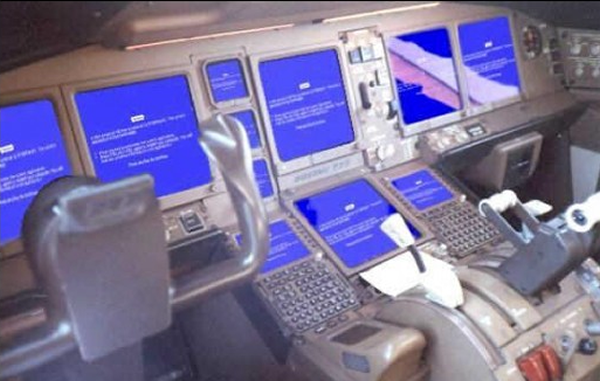
It’s about the doomed Air France Flight 447 and the tragic errors made by all its pilots, and about the risks of automation.
I’m not a pilot and I don’t think I could have done any better. I’ve only handled a plane in level flight and with someone watching my every move as I lightly banked left and right.
But you have to wonder what those guys were thinking. I’m as I noted not a pilot and therefore I only know two real things about flying. One is that if you don’t use your instruments in the clouds and at night, you are probably going to die as humans can’t really determine their orientation without external input (the horizon).
The other is that if you are not near the ground and are stalled, point the nose down.
It’s not clear to me even reading all the analysis why none of the three pilots ever thought to do that last bit, or at least why one of the senior pilots didn’t order it done and then enforce that command.
I don’t think most people realize it but we are already relying on computers, systems and robots too complex for anyone to understand. The article that I linked to really makes the benefits and the drawbacks – and there are plenty of both – clear.
Global warming and global climate change is real and it’s going to happen. We won’t do much to stop it. 
I doubt that alone will cause the extinction of humanity. No, if that were to happen in the near future it would probably have to be similar to how the dinosaurs (sans avians) went extinct – a combination of global calamity like an asteroid strike, climate change and contagion. Or this.
We could get that with a nuclear war in combination with climate change, which isn’t too unlikely, but let’s stick to climate change for the moment.
As noted, climate change will happen. Weather patterns will be altered; seas will rise; famines are inevitable.
But other than those for sea level rise, I wouldn’t put too much faith in regional-level models for climate change effects. Those look pretty iffy and contingent to me, especially since never in  the history of the planet has carbon dioxide risen so quickly – that we have good records for, anyway.
Which actually makes it worse not better, by the way! It means we don’t know what the fuck is really going to happen, but there’s not a bit of a chance it’s going to be good.
The do-nothing crowd apparently also doesn’t believe in insurance or any other planning for the future, either. I know they are motivated by greed and are influenced by propaganda, but it’s so hard to understand how a group of people can be so resolutely idiotic.
Well, at least be consoled by the fact that most of the people reading this blog will be dead when things really get bad. It’s your children and their children who will be climate refugees, starving to death in Anchorage or St. Petersburg or Stockholm.
I’ve made fun of Nicholas Carr in the past. He has written some of the least-perceptive works about IT I’ve seen.
However this is really the opposite. It’s quite good and makes points many commentators miss or are perhaps afraid of bringing out into the open.
We have had a hard time thinking clearly about companies like Google and Facebook because we have never before had to deal with companies like Google and Facebook. They are something new in the world, and they don’t fit neatly into our existing legal and cultural templates. Because they operate at such unimaginable magnitude, carrying out millions of informational transactions every second, we’ve tended to think of them as vast, faceless, dispassionate computers — as information-processing machines that exist outside the realm of human intention and control. That’s a misperception, and a dangerous one.
Modern computers and computer networks enable human judgment to be automated, to be exercised on a vast scale and at a breathtaking pace. But it’s still human judgment.
Of course tech companies like to pretend they are impartial arbiters of information. This sham is to their benefit. And many people believe them.
But Google removes millions of “piracy” links a month. They manipulate their search algorithm daily. They try to corral and herd you into what makes it easier to serve more specific ads to you with tools like “Suggested Search” and “Instant Search.”
Allowing such an overlord to control what we see – and can see — every day is far more dangerous than anything humans have yet created I think.
In my opinion the Left uses the idea of social conditioning too much.
Well, the Right – let’s not even talk about their crazy ideas. I talk about and criticize my side because it’s the one I care about.
Anyway, it’s an omnipresent idea on the Left that we are only attracted to certain bodies because that’s what we were conditioned with as we matured.
I think this is to some extent true, but the Left stupidly believes this is 99.9% of attraction and I’d guess it’s more like 20% to 30%.
Testing these things is nearly impossible, however.
It’s also probably a sliding scale of social conditions, economic conditions and other factors that are hard to quantify.
This relates to the self-excusing idea that as more Americans become unhealthily fat that men just aren’t attracted to obese women because it’s some sort of social conditioning.
I disagree, for the most part.
 Physical attraction (for both sexes) is probably at least partially based on using phenotypical proxies for genotypical health and fitness and is not acculturated. I’d guess 80% or so, but who really knows.
Anecdotally, I’ve always been attracted to thin to very thin women; I had a babysitter when I was no more than four named Anita who was very tall, lithe and athletic.
At the time I thought she was the most beautiful girl I’d ever seen.
Nope, even I hadn’t been reading any magazines or consuming all that much television at that point. It had never even occurred to me what sort of girl I liked before I saw her.
Anita however was so lovely to me it was absolutely galvanizing; I could barely talk to her. (This is why I also believe that gay people do know they are gay very early. I certainly knew I was straight that early thanks mainly to Anita.)
I’ve always been attracted physically to thin women. I don’t think is something that was acculturated in me. And nope, for the Freudians, my mom wasn’t thin and neither was anyone else in my family.
The Left has its own fairy stories that aren’t nearly as pernicious nor as harmful as the Right’s, but they exist nonetheless.
That attraction is mostly acculturated is most likely one such story.
I don’t care for South Park and don’t watch it, but this is really funny.
The latest South Park episode is a hilarious smack down on the NFL’s inability to do anything, the Washington Redskins name controversy and startup culture. The episode kicks off with the gang listing off possible names for their startup like “Dense Boner Forest” and “Furry Balls Plopped Menacingly On The Table, Inc.” You will possibly be offended and possibly laugh your ass off. This is South Park, after all.
“Dense Boner Forest” describes most start-ups pretty well.
I have some small sympathy though for the hiring managers. Ever tried hiring a woman in IT? I have. Or at least hoped to. Sometimes there are NO candidates.
It’s not unusual to get 500 resumes from, say, a systems administrator job posting with exactly zero of them coming from women.
Hard to choose from zero candidates. But at least the interview would be short.
Getting women into the pipeline has to start earlier, and the misogynist culture of my field tossed out the damn window. This horrible culture is of course what prevents many women from entering the field in the first place.
Here’s all the programs I’m currently using as seen on my taskbar.
 Note that this isn’t unusual; sometimes it’s more. Also note that for the pedants in the group, no I don’t use these programs “all at once” but many I like to use side-by-side and consult between as well as copy and paste between them frequently.
In addition, I switch between them rather rapidly so having them open at the same time on a 30″ monitor is a real win time-wise for me, especially as the window then stays where I want it to.
For the really bored, here’s what they all are in order from top to bottom:
1) Firefox – two windows, 17 tabs. One window for work, one for play. Small number of tabs for me. Usually it’s 40+.
2) Locate32 – Best search out there by far, replaces the abysmally criminally terrible Windows search for me.
3) VirtualBox – With two virtual machines running. Use for all testing and labbing. Sometimes there are 10+ running if I am working or studying heavily. Main machine has 32GB of RAM.
4) Transmission RemoteGui – Used for monitoring the Transmission Daemon on our Linux server.
5) CPUID HWMonitor – Temperature monitoring.
6) ConEmu – Console emulator that can run multiple consoles at once (PowerShell, Putty, Windows command line, etc.) side by side. Check it out, it’s great.
7) MetaPad – A text editor.
8) KeePass 2- Password manager.
9) VCE Player – Exam simulator for practice tests.
10) PDF-XChange PDF Viewer – Duh.
11) NotePad++ – Text editor I use when MetaPad is not hefty enough.
11) Control Panel for Windows – Umm.
12) GNS3 – Router simulator.
13) PuTTY — Associated with GNS3, part of that package is why it’s not in ConEmu.
14) Calibre e-book viewer – Yep.
15) Calculator – It calculates and stuff.
16) Windows Explorer – That’s what it do.
17) Microsoft Word – When I want to torture myself.
18) NoMachine NXClient – Remote GUI for the Linux server.
19) Microsoft LiveWriter – Blogging software, far better then the web interface.
20) Adobe LightRoom – Editing photos.
21) Terminals – Remote desktop, VNC, etc. into other machines.
22) Thunderbird – Email.
To those tempted to say that I am using my computer wrong: get a life. I’m using it in exactly the way that works for me and furthermore I am probably faster than you at it. Also, I am a cocky bastard.
Anyway, that’s what my computer usage looks like. All of these are open and are being used, by the way. None of them are pinned to the taskbar (I use RocketDock so nothing is pinned). Sometimes there are 20-40 more programs open than this when I am really working and/or studying, but this is my more casual usage.
I also jump between things a lot which is supposed to be bad, but there doesn’t seem to be much if any context-switching penalty for me even if I am working on something complex. That is a very lucky thing — I am aware of that and grateful for the ability.
And this is also why I can’t use a tablet for anything productive. The things I do on a real computer are outright impossible (router simulator, VirtualBox) or would take a day to do what I can do in five minutes on my main box.
I remember when the internet was first becoming a thing.
There was a great Qwest commercial shortly thereafter about the future of society with something like the internet in it. It had a woman (if I remember right) standing at a concierge counter asking what movies were available at the hotel.
The conceit I believe was that this future hotel had the internet so the person at the counter said, “We have every movie ever made in any language – ever.”
That’s the future that very much could’ve been but that we’ll never get.
In fact due to copyright and greed, we’re likely only to be able to access tiny and uncontroversial parts of our culture in the future.
Note that this is already occurring.
The difference between what could’ve been and what will occur is so vast it’s almost painful.
I can’t use streaming because 90% of the movies I want to watch just aren’t there. And it’s getting worse, not better.
I had better selection at a crap VHS rental store in a hick town in 1988.
The goal of corporations now is to pillage and pilfer our shared culture and rent it back to us at exorbitant and ever-increasing prices.
And they are doing so with nary a protest from us.
Perhaps in that respect we deserve what we get.
Here you can see the history of automation, in one graph.
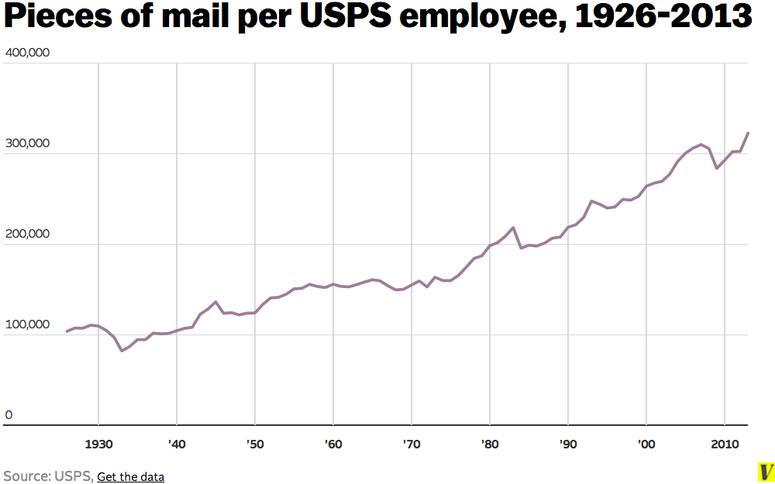
From here. Notice how recessions cause mail volume to fall, thus mail per employee. Automation in the postal space is only medium difficulty, so it’s a good proxy for the “average” job. By this very limited measure, productivity is now a little over three times higher per employee than in 1930.
[A] novel is the only place in the world where two strangers can meet on terms of absolute intimacy. The reader and the writer make the book together. No other art can do that. No other art can capture the essential inwardness of human life.
(That said, in the future VR will be able to do that too, but oh how the traditionalists will howl. As they always do.)
When I was naught but a tiny whippersnapper, I thought that all movies that featured characters at different ages had to use the same actors – so in my mind if a film showed a character at six years old and then as a 40-year-old, the filmmakers must have waited 34 whole years to complete the movie.
Therefore it was amazing to me as a five-year-old that any movies like this ever got made.
I figured it out not long after, of course.
Deceptive I thought it was to do anything else. I don’t know why.
I’ve seen claims that the tulip mania that occurred in Holland in the 1630s was rational. I’ve seen the same claim for the housing bubble in the US in the early- to mid-200s. I’ve also often seen the assertion– totally revisionist and ridiculous – that “no one could have known!”
I guess you can define “rational” any way that you want, but bubbles are rational only if you believe that asset prices can rise to infinity.
Doesn’t sound all that rational to me – and notice that I did not buy a house during the bubble though I certainly could have afforded one where I lived at the time. This is because I was aware of it. So were many others.
Just as I was aware of the stock market bubble in late ‘90s and early 2000s. A story about that at another time, perhaps.
Not a great act of genius in either case, though. Some things are just obvious.
So many people are bankrupted and impoverished by bubbles that they’d like to believe that the actions that occurred during the boom – including their own individual actions – were rational.
 Perhaps on an individual level there is a marginally-applicable case for a small part of this due to inequalities of knowledge.
However, the powers-that-be like to impute rationality for their marks so they can avoid helping their victims, while at the same time claiming irrationality in their own affairs to avoid criminal prosecutions and to prevent the government from taking away their toys (that is, the ability to blow up the economy at will).
Are there any financial or asset bubbles right now? I only know the US all that well, but there is one, but it’s not that large as bubbles go.
Tech is again in a bubble, but only a relatively-small part funded by VC. When it blows up – which it will – it won’t have much effect on the economy.
What do these critics and academics even mean when they call adult literature serious? This descriptor gets thrown around but never defined. Were I to make the same reductive assessment of all adult literature that the genre’s critics make of YA fiction, then the serious novel would be about a middle-aged person struggling with career collapse and sexual frustration. I don’t want to belittle these topics, but they’re only serious to sexually frustrated middle-aged people, coincidentally being the same narrow demographic that adult literature seems to serve. And they clearly don’t read as many books as their kids.
It amazes me that supposed experts in critical theory, textual analysis and semiotics cannot for the life of them recognize the use and societal relevance of large-scale allegory and metaphor in works of sf or YA. It’s almost like they, say, are a little biased. But that couldn’t be, right?
Do read the Guardian piece, though. The conclusion is just great.