As with the below, the best novels about men are almost always written by women. It turns out that neither gender can see itself all that well.
See Middlemarch and Gilead for examples.
And the ur-example is Mary Shelley’s Frankenstein.
As with the below, the best novels about men are almost always written by women. It turns out that neither gender can see itself all that well.
See Middlemarch and Gilead for examples.
And the ur-example is Mary Shelley’s Frankenstein.
Elena Ferrante and the people who vouched for her.
I am 100% convinced that “Elena Ferrante” is a man. No one but a man can write about women so observationally and so lucidly (with rare exception).
I’ve read everything by “her” now in both English and Italian and it’s pretty darn clear that Elena is a man. Women never write about fellow women so unflinchingly but with such empathy — their natural intrasexual competition drive almost always gets in the way.
The 100 best novels of all time.
Cool. I have read every one of these.
My least favorites of that list: Ulysses and Jane Eyre. Both pretty boring pretentious crap.
My favorites: Never Let Me Go, My Brilliant Friend (is far better in Italian), and Frankenstein.
Not as bad a list as these typically are, at least.
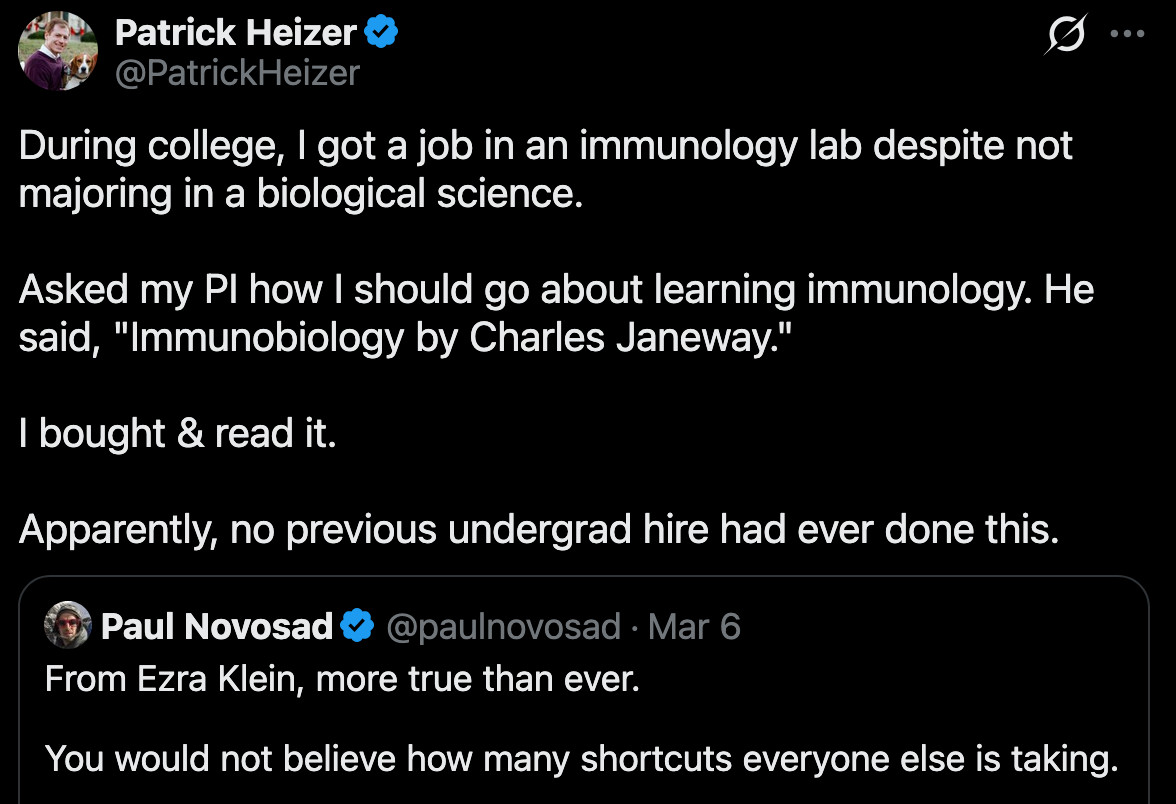
When I figured out many years ago that you could read one good textbook about a subject and know more than 50% of “experts” in the actual field and 99.999% of laypeople, I was flabbergasted. Most people — again, even the experts — simply have not done the work.
If you read and understand ~3 books in a field of study, you then know more than ~95% of experts and 99.9999999% of laypeople. I’ve done this in roughly 100 fields, though some I need to refresh on since it’s been two decades.
(I’ve read the Janeway Immunobiology book, by the way. It’s very good! Basic Immunology: Functions and Disorders of the Immune System by Abbas et al. is also great.)
I read Moby-Dick in third grade. Yes, I understood it all just fine and I also loved it. The Hobbit — if we were any kind of real civilization anymore — is more appropriate for normie 7-8-year-olds.
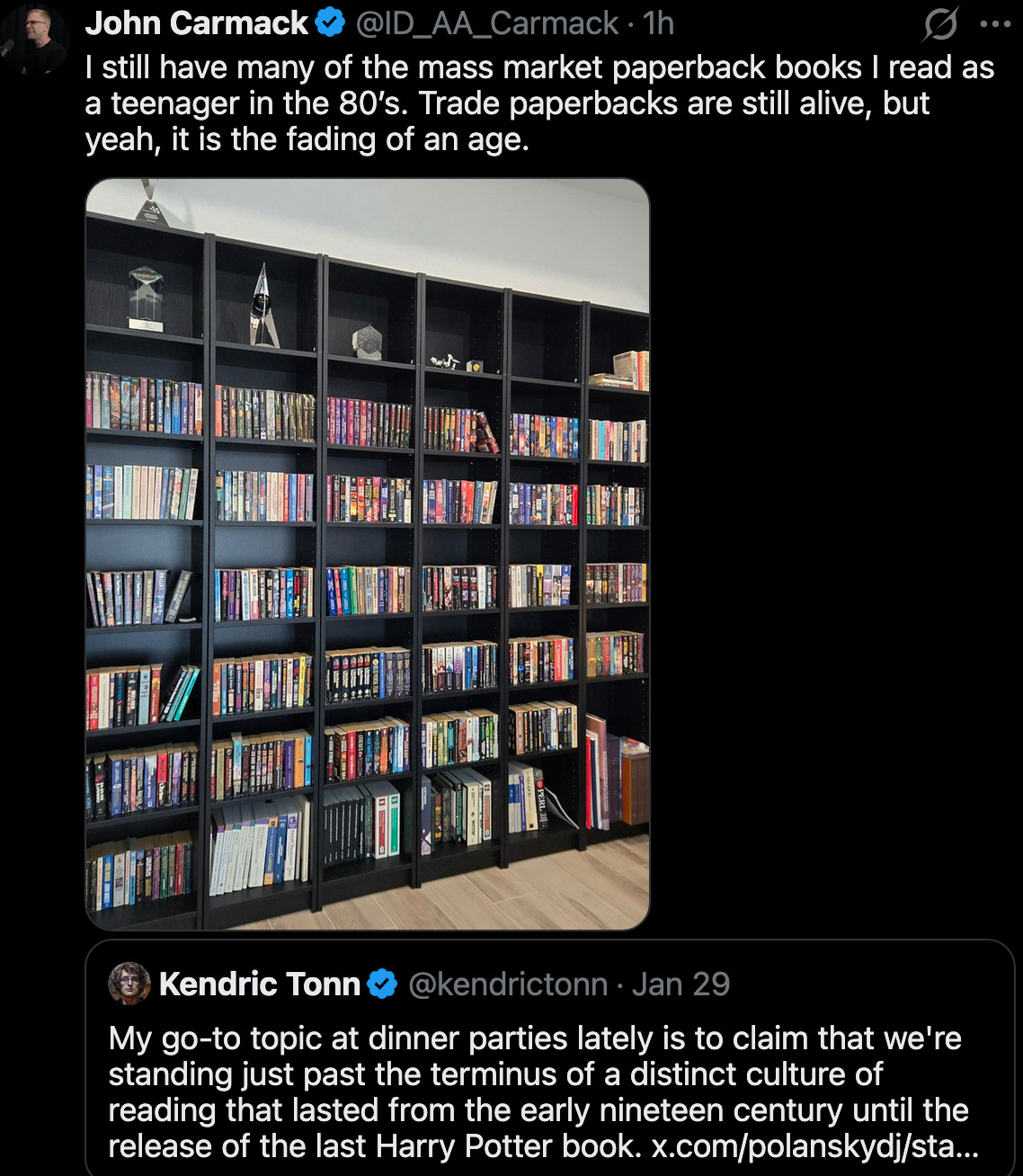
The era of widespread literacy is now behind us. Not sure what the future will bring, but a lot will change due to this massive societal alteration.
I’ve read 5-10 books about nearly everything. What does that make me?
This is correct, though. Most people — and even a lot of “experts” — are woefully uninformed. If you read a couple of quality books about a subject, you know more than nearly everyone, and more than about half of “experts.”
The revelation that the incredible stories told by Oliver Sacks were fabrications joins the replication crisis to create feeling to sad disillusionment. The things I was so excited to believe in my gullible 20's just weren't so. Mugged by reality. https://t.co/xNs5qLfiGn
— Seasonal Clickfarm Worker (@ClickingSeason) December 12, 2025
I didn’t read Oliver Sacks for just this reason. Made it through a quarter of one of his books, don’t even recall which one, and said, “This sounds like BS.” Put it down, never picked up another of his again and never really thought about him again either.
I have a really good bullshit detector.
I went to the book club. There were way too many people to have a good discussion. As I pretty much expected, I was the only dude. Men don’t read anymore. It’s become completely feminine-coded. Weird.
The facilitator (who was very good) said there were 10 different book clubs at that location before Covid and now there’s only one. That demonstrates how much sociability has declined since that time. Afterward, I suggested that it’d be worth dividing into separate meet-ups again as 20+ people is too many for an in-person book club. She agreed but said staffing was now an issue.
I’ll go to the next meeting, but mainly because it’s a book I intended to read anyway. After that, not sure. This group was not very intellectual and I think I need that to have a good time.
Book club today!
It means I have to dial back my know-it-all-ness (hard) and not say shit like, “This was somewhere around the 15,000th book I’ve read in my life.”
I’ll manage. Somehow.
I can finish a medium-hard 200 page book in about two hours. I can get through a difficult 300-page book (prose) in about five hours.
I can finish the average potboiler book in an hour and a half. The last time I read a book on a flight, I started and finished Tilt by Emma Pattee on a one hour and 21 minute flight.
Sorry about all y’all’s limitations, but they aren’t mine. Not in this realm.
I’m going to a book club on November 15! In person, that is. I don’t do virtual events because they really suckkkkkkkkkkk. At least for me. If I wanted to be on yet another Zoom call I’d get a second job.
Naw, y’all, it’s got to be real if I’m gonna be part of the deal. Should be fun.
Today I started a mystery novel from the 1920s. Not highbrow at all (Austin Freeman). In the first 5 pages, there are two Latin phrases, a French one, and references to Hippocrates, Solon, and the Bible
The standard of literacy was higher in the past https://t.co/uKhVlHBS0T
— Kayla (@caryatis) September 1, 2025
I was reading a philosophy book from the 1920s fairly recently. There were (untranslated) phrases in Ancient Greek, Latin, French and German. I could read all but the Ancient Greek of course, but that many languages is gonna be a big lift for nearly all modern people.
Fewer people were literate then, but the standards certainly were much higher.
It feels sort of wrong to criticize it as I have not read it and will never read it, but Ada Palmer has a deeply stupid book out arguing that the Renaissance was fake.
Fucking Christ.
No one — literally no one — believes that the Renaissance was some golden age. When your entire work is arguing against a straw man why write it in the first place? Most educated people know that time period was one of conflict, massive social change, and unrest. The era also saw huge innovations in art, proto-science and political organization. In fact, there was far more change in a roughly 200 year period than there had been in the previous thousand years of Western civilization.
In a tortuous series of events, this denial of the obvious is at least partly (perhaps wholly) the result of broken academic anti-racism crusades. Here’s how it happened: To fight racism, scholars who wanted to keep their jobs started believing two things:
1) That if there is a continuous gradation, then there is no difference between any two items in the distribution. In their view, a mountain is the same as a molehill with no relevant distinctions1. One can see how this specious line of thinking could be used to battle racism (and it was).
2) That no culture should be judged for any reason, no matter how vile.
Combine these two and you get wacky-ass shit like believing the Western Roman empire never fell and that the Renaissance was fake news. This, however, is a terrible way to do scholarship or to understand the past. Under this chowder-headed view, nothing of consequence has ever happened and no culture is better than any other.
Both obviously extremely false assertions.
I love starting a book so arcane and exotic I cannot tell from the title or the first few pages if it’s going to be absolute nonsense or something brilliant.
That’s the best kind of book.