I don’t really give a crap who wins the caucuses or the election, but I really want to watch this film.
The Polish director’s debut feature-length film is like Cronenberg at Disneyland, a Grand Guignol musical fairy tale of two mermaid sisters who are quite literally fish out of water. We first meet Golden and Silver as they are trying to lure a family of musicians to a watery death, only to strike a deal with them that leads to the mermaids joining their band.
It’s the anti-Splash. And don’t misread me — I like Splash. It has crazy charm and energy and some great lines, mostly from John Candy. And it’s the closest thing there is to a romance novel aimed at men*. But recognizing it proffers a certain worldview, I also enjoy seeing things that disclose another.
And now I will write an aside that’s longer than the main post. Watch this trick y’all.
*The “misogyny” explanations for why men like Madison from Splash don’t hold water (see what I did there). It’s not her naïveté (which actually she is not except about human customs). The actual reason is that she’s completely guileless — something that is beaten out of both women and men by the barbarity of our world. That is the point of the movie, and if you missed that point you should really reconsider criticism altogether.
Madison represents the ideal lover who glimpses and even reveals to you your model self — the coin of the realm of all romance novels. Every person alive knows that most dating is deception, and Splash explodes that and examines it. It also cheerily but quite subversively for an 80s movie skewers social conventions and what we are expected to want vs. what we actually desire and what would make us happy.
It also helps that it’s probably Ron Howard’s most nuanced and darkest movie. Seriously, watch it again. The scenes where the scientist is discussing dissecting Madison to study her are harrowing in a way that few movies achieve because the character investment is so high and the characters as drawn seem so present. They also seem to be in real danger, unlike most fairy stories where the ending is assured.
It’s also Howard’s best-shot movie; the cinematography is superior to that of Apollo 13 and even the quotidian cityscapes seem enchanted which befits the tone of the movie. And the camera more than in any of her other films just loves Daryl Hannah — she doesn’t look human (in the best of ways) even when she lacks a caudal fin. It is also her finest performance — when she realizes the pain, the avarice, the cruelty, the woe and the misery ineluctably at the very heart of the human world, the emotion of that realization just radiates palpably from her like some malignant steam escaping:
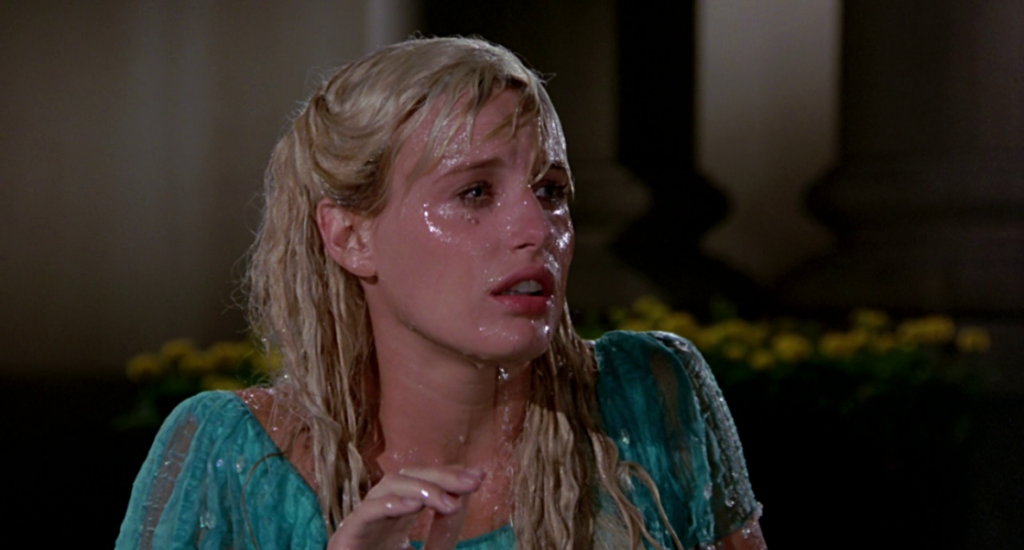
But back to the darkness — Madison’s tale (see what I also did there) is the story of how the world as we humans make it suppresses and impedes our best intentions, hardens us, jades us, gives us armor but also its inevitable distance, and the film compresses all that for Madison into weeks of hard lessons and for us movie-goers into a few hours of recapitulation of that baneful edification.
Splash is a tragedy masquerading as a fairy tale. Sure, Madison escapes and Allen her paramour elopes with her — but the world that nearly vivisected Madison, that also nearly killed Allen for loving her, that sent Marines to capture or kill a harmless wonder that in a saner world would’ve been recognized as fully human right away — is still there, just as it was, unchanged, its evil unaltered.
That is the tragedy. And that is not indeliberate in how the film’s story is spun.
Now some trivia. “Madison” was a really uncommon name before Splash; the film popularized it. I remember how unusual and ridiculous it sounded when I watched the movie some time in the 80s. It was chosen specifically because it sounded absurd. Now it doesn’t.
Daryl Hannah’s mermaid tail took eight hours to put on.
