Yoda or da not

Overheard in a Target:

Little girl: But I want the Yoda! The Yoda!

Mom: But you don’t want that one. That’s not the one for you.

Little girl: But the Yoda! I want the Yoda for my basket!

Mom: That’s not the theme and that’s not what we’re doing.

Little girl: The Yoda! The Yoda! I want the Yoda!

Mom: Quit complaining. We’re not getting the Yoda!

Little girl, being led away: But I want the Yoda! Yoda! Yoda!

The context was more clear in person — it was pretty apparent that the woman did not want her daughter to get something “unfeminine” like Yoda, that it was the wrong choice for a girl.

The conversation actually went on for a lot longer — about seven or eight minutes of the girl begging for some sort of Yoda thing for her Easter basket and being repeatedly denied and forced to make another choice.

Sexism is real and it exists; much of it also perpetrated by women against other women and even worse mentally-defenseless little girls, as no one is immune to and insulated from the patriarchal environment in which we all live.
Found it

Found the post I was ranting about below, and I figured out the trick the guy pulled. My memory was faulty, but there was indeed a a large deception.

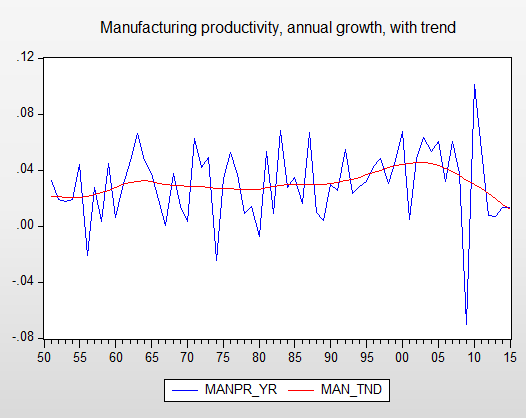
First, the robot story implies an acceleration of manufacturing productivity (more output with fewer workers equals faster productivity growth), for which there is no evidence.

Can you detect it? Nice and subtle. An “acceleration” of manufacturing productivity. Not an “increase.” It only takes a small annual increase of a few percent to double output with the same number of workers over time. But to “accelerate” the increase of manufacturing productivity is a whole different thing — this means if you measure the acceleration of the increase (which hasn’t happened) you’ll get a nearly-flat graph where it looks like productivity is flat. Which is bullshit.

It’s like saying your car isn’t going any faster because though you’ve gone from 60mph to 80mph, you’re actually not going faster because you went from 10mph to 30mph with much greater acceleration.

Nice trick. I admire the intellectual chutzpah it takes to pull such things because only a small percentage of people will know you are wrong, but those who do know will really know it.

This dude’s graph, which isn’t actually graphing what it claims to, but rather the “acceleration” I mentioned above:

manemp2

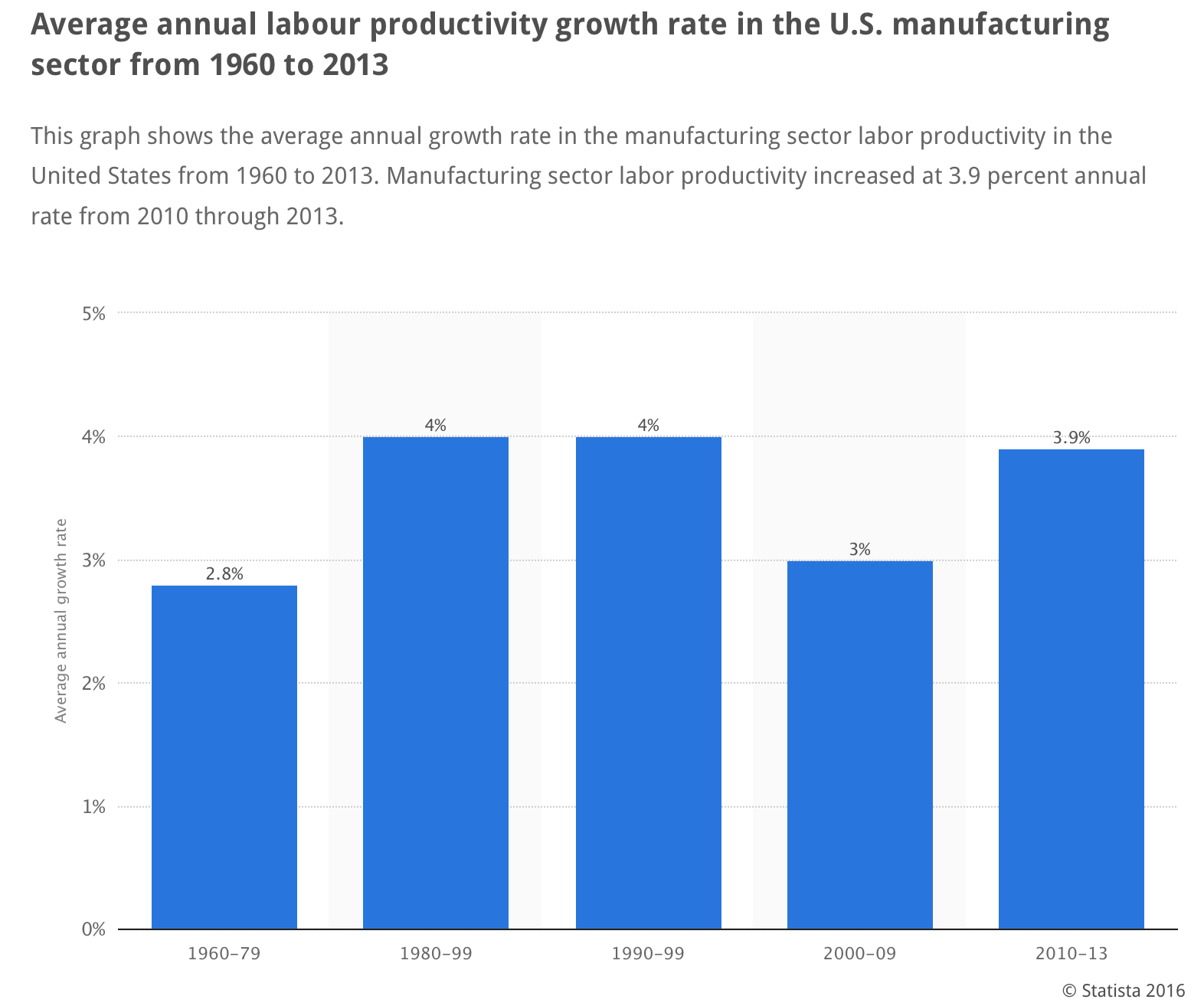
Reality:

growth

Note that in the above, the productivity rate is per annum, averaged over a decade. So that means that a 4% per annum increase in a decade leads to ~50% greater output per worker in only 10 years. But it’s not accelerating, and never really has, so you can make a nice flat graph if you plot that. Which is stupid.

Productivity

First a quote, then I’ll put the moon rover in gear and we’ll get where we’re going.

โ€œThe purpose of studying economics is not to acquire a set of ready-made answers to economic questions, but to learn how to avoid being deceived by economists.โ€

โ€• Joan Robinson

I’ve lost the link — I read way too much — but I was on an economics site that claimed that US factory productivity had not increased at all since the 1950s.

This contradicted everything I’d ever read and every number I’d ever seen, so I decided to look into it more. I’m guessing it was some sort of agenda for justifying why so many jobs had been shipped overseas, but done really well so that it was “obvious” with cooked numbers. More convincing that way if made less clearly ideological.

Dammit, I wish I could find the link.

The mistake or deliberate obfuscation this person made appears to be that they took the BLS numbers of factory output and somehow manually adjusted them to show hours worked per worker without adjusting for decrease in worker number vs. hugely increased output (same number of workers producing far more, in reality). The same number of workers can produce in 2016 1,000 cars a month, and could’ve rolled out only around 200 in 1950. Etc. Anyway, it was completely wrong so if you find it or something like it, please let me know.

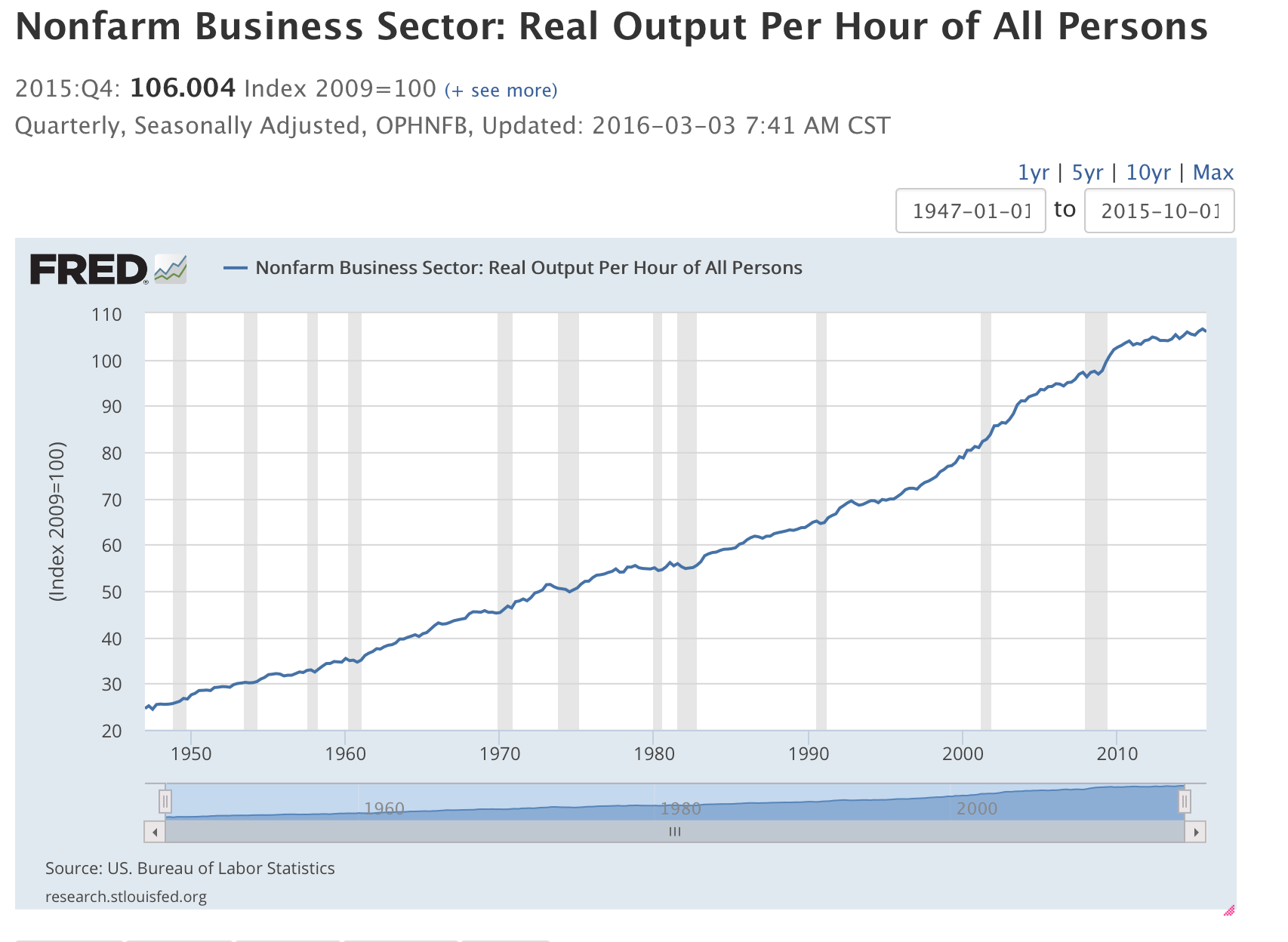
So here’s the data as it should actually be calculated. The FRED.

realout

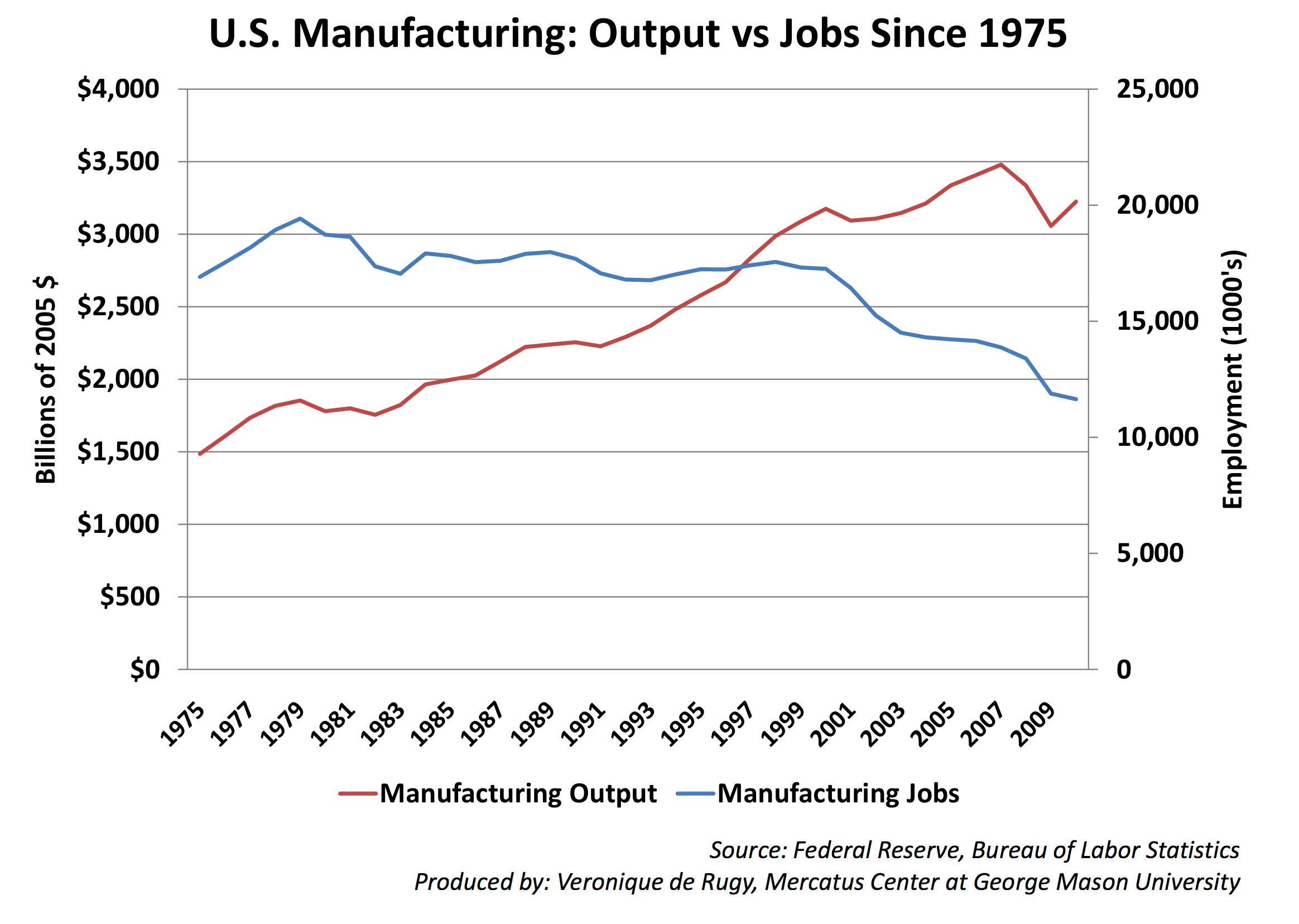
Just manufacturing since 1975:

us manu

So as you can see we produce much more with much fewer jobs over any series of more than a few years which you care to examine, in any category.