Dual

Not all dualists are interactionists, however. An important alternative version of dualism, called epiphenomenalism, recognizes mental entities as being different in kind from physical ones yet denies that mental states play any causal role in the unfolding of physical events. An epiphenomenalist would argue that mental states, such as perceptions, intentions, beliefs, hopes, and desires, are merely ineffectual side effects of the underlying causal neural events that take place in our brains. To get a clearer idea of what this might mean, consider the following analogy: Imagine that neurons glow slightly as they ๏ฌre in a brain and that this glowing is somehow akin to conscious experiences. The pattern of glowing in and around the brain (i.e., the conscious experience) is clearly caused by the ๏ฌring of neurons in the brain. Nobody would question that. But the neural glow would be causally ineffectual in the sense that it would not cause neurons to ๏ฌre any differently than they would if they did not glow. Therefore, causation runs in only one direction, from physical to mental, in an epiphenomenalist account of the mind-body problem. Although this position denies any causal ef๏ฌcacy to mental events, it is still a form of dualism because it accepts the existence of the โ€˜โ€˜glowโ€™โ€™ of consciousness and maintains that it is qualitatively distinct from the neural ๏ฌrings themselves.

-Stephen Palmer, Foundations of Cognitive Psychology: Core Readings

Brilliance

What a strange question.

Brilliance doesn’t significantly decrease the tendency to make mistakes, it just allows one a bigger scope of mistake-making. Combine that with the Peter Principle, and then truly brilliant people can make world-altering errors.

Also many brilliant people accustomed to succeeding often get the attitude that, “I’m really good, therefore anything I do is great, so unethical or illegal action X is also just fine due to the transitive property of my awesomeness.”

Not that I know anything about that personally.

No. That was, uh, about a friend. And stuff.

Drum Minor

Could Kevin Drum be a bigger nitwit? I’m sure he could find some method, but it’s a distinct challenge at this point.

Drum minimizes facts that are massive and important because he’s old, owns his own home, has gold-plated health coverage (dude has cancer — someone 25 years old would probably be homeless or dead right now with his same condition) and is terrified of his house price falling a few percent.

It’s like in Drum’s mind we didn’t just have this thing called the Great Financial Crisis that completely nuked the hopes, aspirations, dreams and future of a whole generation of people.

And I benefited and continue to benefit from this crisis myself in several ways! But it doesn’t make me blind. And it didn’t turn me into a goddamn moron. For instance as to personally benefiting, I put money into the market when it was near its lows, and also there is a whole generation of people who will never catch me in the job market (evidence shows those who start working during a recession stay behind their whole careers). That eliminated 20 or 30 million people in the US alone that I will never have to compete against; they will always be behind me.

But as I said it doesn’t make me not see how devastating politics as usual has been to people slightly younger than I am.

How can you be someone like Drum, just so oblivious? I don’t understand. And pretend things are so great when conditions are like this in America.

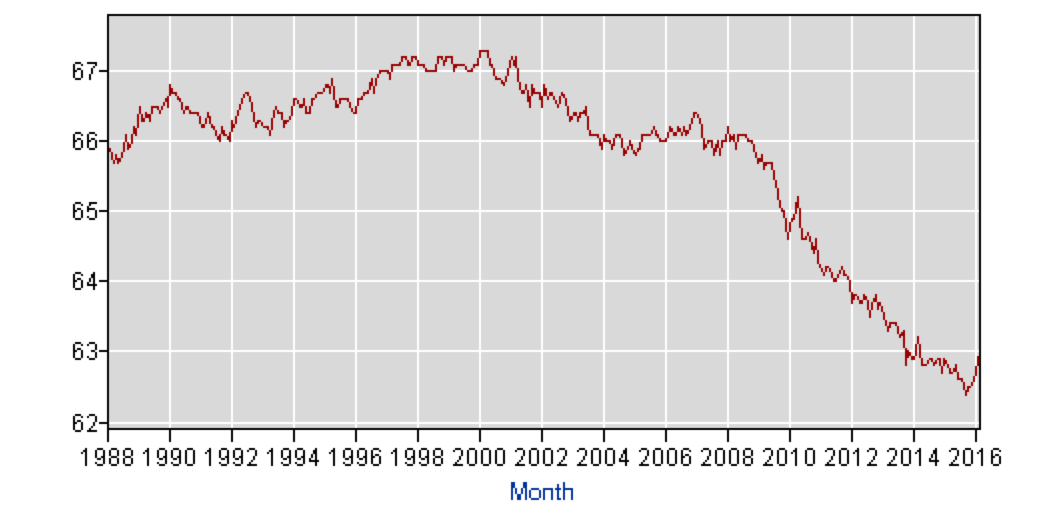
Another fact. Drum says that, “Yes, two or three percent of the working-age population has dropped out of the labor force, but the headline unemployment rate is 5 percent.”

Here’s the BLS graph of Labor Participation Rate from 1988 to 2016.
labpart

Just the raw numbers from the comparative heyday of the late 1990s, that’s a four percent drop. Some of that though is due to population aging. However, that’s still approximately 11 million people not in the labor force anymore.

Assuming roughly forty percent of that is due to demographic factors, that is still over five million people whose prospects are so poor that they don’t even bother to look for work any longer. Five million people is not minor. Not even in a country of 300 million. That’s a crisis. That’s the entire population of Atlanta, just gone from the market altogether.

Countries have had revolutions over much much less, by the way.

People like Drum aren’t the only problem with the country, of course. Not by a long mile. But is Drum and people like him part of the problem? Oh yes. A huge part.

No, I don’t think Bernie would’ve solved this or any problem, by the way. I don’t even think Bernie would’ve been a good or effective president. But at least Bernie was talking about the issues, about the way the future will play out. About the devastation that has been wrought and why it occurred.

Clinton and Drum are stuck in the past, worshipping old dead gods in a sepulcher where they’ll soon be entombed, unremembered and unloved by a future that finally gets to move on from their amaurosis and self-absorption.

Good riddance to them.

Being nosy

So much hinges on luck, on the off chance, on the serendipitous.

Though I’d been working with computers since literally before I could hand-write my own name, after I left the army I had trouble at first breaking into the IT field.

I interviewed at many places for IT work — helpdesk, network tech, and many others. “No experience,” they said. Even though I’d been doing all the IT support for my Army’s journalism office for four years in addition to journalism duties. Even though I was in many cases vastly better and more knowledgeable at the positions I was interviewing for than the people interviewing me.

So I’d pretty much given up on IT. This was in 2000, after my brief stint as a lead writer.

Looking for work, I had gone to a temp office to seek out a job, just to get experience in any field.

I just happened as I was sitting there to overhear another conversation. A recruiter was discussing with someone that a local company needed a proofreader.

I interrupted (something very unusual for me) and said, “Proofreader? Is there a test you can give me? I was a journalist and editor for years. Proofreading is something I can do in my sleep.”

So she gave me the test and I made a perfect score on it — the only perfect score they’d ever seen.

I literally got the job on the spot. I started the very next day.

But that was only the first step. I had no idea that brief overheard conversation would lead me into the IT field.

One night, though, as I was busily proofreading on the late shift (and managing my team; I got promoted) a server died and needed to be restarted. They had someone on the night shift who was supposed to handle IT matters, but this person was unable to even find the power button to this server to hard reboot it.

Yet another overheard conversation later, I was in the server room, identified the server having issues, powered it off and verified that it returned to life.

It wasn’t much later that I was invited into the IT department on a trial basis, part time.

Then it went full-time, and about a dozen promotions later at various companies I’m still in the IT field — all thanks to not one but two overheard conversations.

Glad I’m a nosy fucker, aye.