Ment

An intern I’ve been mentoring at work told me that I’m a better teacher than any she had at Duke.

Which charges $60,000 per year.

I need to go into a different business.

I have a mentee, but what I actually wanted was a manatee.

Ok, it’s pretty cool to have a mentee really. But a manatee would be cool too.

Rev 2

Oh my fucking god. Old people are smoking crack.

But he didnโ€™t start this. The renewal has been going on for the last seven and a half years, led by the most successfully progressive president since LBJ.

You know who was more liberal than Obama? Richard Fucking Nixon.

A Republican.

Why are people like Lance Mannion and Kevin Drum and so many more so hell-bent on smacking down Sanders after he’s finished? He’s lost. It’s done. I guess they want to make sure the entire movement is quashed, too. (Can’t let those house prices even be threatened even a little bit.)

Mannion has no clue how the federal budget or economy works, either. The federal government is not funded by tax. Know what happens to the money you send to the IRS? It’s essentially destroyed. If you were sending physical money in, they’d throw it into an incinerator.

According to Mannion:

1) Clinton being a woman makes her magically progressive (just like Sarah Palin?)

2) Sanders did nothing of consequence that others hadn’t already done.

3) Being corrupt is just part of being a politician. Sanders isn’t a real politician because he’s not corrupt like Clinton.

4) Hillary is to the left of Bernie in some areas. (Ha.)

5) Obama did all he could possibly do, the poor little baby, to help but the meanies just wouldn’t let him do more!

I’ve heard of revisionist history. But revisionist present is something we need a more concise term for as it’s becoming so common these days.

Mismeasure

One of the many problems with economics as currently formulated.

Economists make a grave mistake when they fail to mention open-source software as one of the critical innovation of our era.

The economics profession as far as I can tell is completely unable to deal with anything that doesn’t directly intersect with official currencies in a standard inflationary monetary environment.

In other words, anything that isn’t on an official balance sheet somewhere is utterly ignored no matter how much effect it has on the actual economy.

In fact, it’s worse than that — anything that actually helps real people is a net negative in economics! To see why this is so, imagine if there were a machine created that provided free energy and also could create any product up to the size of a house ex nihilo.

According to the economics profession, the economy just would’ve cratered. GDP would quickly drop to near-zero as everyone could and would have what they need for free. There would be no profit any longer and the whole concept of profit would quickly become meaningless.

But according to economics as structured currently, the world would be experiencing the most enormous depression in recorded history. This despite the vast majority of the world’s people being immeasurably better off.

Like the above free energy and free stuff machine, open source software, the internet, other communications technologies are all modern artifacts and practices that have made billions of people remarkably better off but are not captured at all (or count as a negative) in modern economics.

Despite the insistence of economists that they actually haven’t mismeasured all of these things, they very much have. The profession can’t help but doing this due to the way it’s geared, and then must for self-consistency insist that its assessments are perfect and capture all that there is to be captured.

Else scary unapproved ways of living and organizing societies might creep in at the edges. And we just couldn’t have that, could we?

Making do

“The gay community made a heroine out of Judy Garland by ‘tearing’ or disfiguring her image of the all-American, all-gingham girl-next-door, and reworked her as a sign of the masquerade necessary to fit this image, a masquerade equivalent to that which, in the days before sexual liberation, permeated the whole of the social experience of gays.

Excorporation is the process by which the subordinate make their own culture out of the resources and commodities provided by the dominant system, and this is central to popular culture, for in an industrial society the only resources from which the subordinate can make their own subcultures are those provided by the system that subordinates them. There is no ‘authentic’ folk culture to provide an alternative, and so popular culture is necessarily the art of making do with what is available.”

–John Fiske, Understanding Popular Culture (1989)

Experience

When I was a kid, I thought adults over-emphasized experience to exercise power, even though they appeared to have learned little from it in actuality.

Given that I’m no longer nearly a kid, I think I was mostly right about that contention.

Experience is not nothing, but it’s mainly used (as I thought at the time) as a method of exerting power over those who don’t have that method of competing in the contest of ideas and action.

While some adults do use experience as a cognitive benefit, most just use it as yet another source of confirmation bias so it’s not a real factor in most decision-making processes in the real world.

O and A

“Since redundancy characterizes oral thought and speech, it is in a profound sense more natural to thought and speech than is sparse linearity. Sparsely linear or analytic thought and speech are artificial creations, structured by the technology of writing. Eliminating redundancy on a significant scale demands a time obviating technology, writing, which imposes some kind of strain on the psyche in preventing expression from falling into its more natural patterns. The psyche can manage the strain in part because handwriting is physically such a slow process โ€” typically about one-tenth of the speed of oral speech (Chafe 1982). With writing, the mind is forced into a slowed-down pattern that affords it the opportunity to interfere with and reorganize its more normal, redundant processes.”

-Walter J. Ong, Orality and Literacy

Throwing

The most underrated band in history is the Throwing Muses.

I speculate the reason they never got their proper due despite being hugely influential and innovative is their music wasn’t surface angry, it was complex, and most of the members were quite femme. This last at a time when denying and denigrating femininity among many — and especially progressive — women was expected. Yes, this was an understandable rebellion against unrealistic expectations but at the time any band that did not do this was seen as traitorous.

For this reason people like Amanda Marcotte and those more intellectually capable still discount Throwing Muses, despite later bands like Sleater-Kinney citing them as major influences.

The Muses forged music in the 1980s that sounded like it was from 20 years in the future. They were also one of the first major female-led indie bands, if not the first (Sleater Kinney as implied above came a good bit later).

If you want to listen to the Muses, “The Real Ramona” is their best album, but all are pretty good.

You’ll probably find them derivative but the reason is because they originated a lot of the sounds and conventions that informed and shaped 30 years of later music.

Blogs today

John Scalzi’s post on how blogs work today is thoughtful, but I still disagree with most of it.

Facebook and Twitter are innately inferior to blogs. The main reason is that both companies (especially Facebook) are tracking and advertising platforms where as the cliche goes you are the product. Both are very user-hostile in any sense I care about.

Blogs — especially when they were mostly self-run — operated under an entirely different ethos and were also much deeper and more ruminative and of course far less beholden to advertisers.

There has been one advantage to the rise of Facebook, though. Most of the very dumb people have disappeared into its maw and aren’t heard from as often since I never go there.

Though Facebook is still hugely harmful to the internet in general, that is a de facto benefit to me that I do actually enjoy.

But that’s about like saying that the shark ate that one annoying person first when you’re both shipwrecked and treading the same shifting sea. The shark’s still there and you’re still in the water.

Puzzlers

One of the most disappointing experiences since I’ve been paying attention to politics (which for me was around 1982 or so) has been to watch people I formerly thought of as intelligent and progressive array behind a warmongering neoliberal.

No, I’m not talking about Trump.

I’m talking about Hillary Clinton.

One of the reasons I started researching how ideas dominate the discourse and how other ideas are eradicated is from this experience, as I realized that even people who thought they remained untainted and unsullied by neoliberal modes of thought were in fact some of the people most in thrall to them. Prior to this being made so apparent, I’d written a little about how there was no discourse possible outside of the neoliberal one but that was just an intellectual examination.

But the realization became a much deeper one with watching bizarre behavior from Sarah Kendzior (and many others) who insists on believing despite all the statistics so easily available that the Sanders campaign was the resurgence of the KKK and was only supported by white men. The numbers just don’t bear this out. The true divide was by age. (You can always tell you are on the right track the proper appellation an ideology when people insist that the word not be used any longer, as with Kendzior and her supporters and the word “neoliberal.” Just as with racists and the “I’m not racist, but….”)

Ok, let’s rein this back in.

The evidence is overwhelming. Arguing that neoliberal thought hasn’t captured everyone is impossible, and “captured” isn’t even the right word as being “captured” implies for most that there is somewhere else to run. In this case, all I see is that those who believe they are fleeing from it run right back into the wolf’s mouth all the while thinking that they are free.

By the way, this even applies to me. There is no complete extrication from neoliberal ideas. Scientists claim brainwashing doesn’t exist, and the movie kind indeed does not; but this kind very much does. To break out of it — even a little — I have to imagine as hard as I possibly can that I’m a 15th Century Incan whose economy and cosmos operates so very differently that “neoliberalism” would be an inconceivable atrocity to living a good life, and that it would not make the least bit of sense as a mode of sustaining a civilization.

And then, it only barely works and only while I’m actively attempting that metempsychosis. Otherwise, I’m just as prone to “market solutions” and believing that living no other way is possible, with neoliberalism’s insistence of it is the natural state, with it as the tabula rasa of the universe itself, and that humans haven’t lived in hundreds of different societies of thousands of different sorts of social arrangements over hundreds of thousands of years.

Has ever a mode of discourse been so dominant as the one we have now? Has ever one so precluded and demolished other methods of inquiry, especially outside of a large religion?

Alas, I am doing a poor job of expressing what I’m attempting to state.

So let me try again: the ideas of neoliberalism have successfully swallowed up entire arenas of human thought and endeavor that were once seen as being outside such considerations. The reification of these ideas is “privatization” and treating the market as if were some actual entity, a Platonic ideal of human society.

But there are three other levels (at least) to what I’m actually concerned with. The first more surface-level one is that ideas and practices that successfully work in other countries and cultures and have done so for many years are seen as laughable, ridiculous, and so absurd as to not even be worth discussing. But again, this is just the alluvium.

The bedrock below is much more interesting, and that is the almost-unavoidable tendency that even when someone realizes that they are having a reflexive neoliberal reaction to then declare another solution that is just as firmly embedded in that accepted dogma while believing that they are rebelling against it.

That and the level below that (which I don’t yet have proper words for) is what I’m actually interested in. Not to trivialize mental illness, but in many ways neoliberalism’s adherents (which is in reality nearly everyone) seem to have the symptoms of a mental illness brought on by trauma, or the threat thereof. Or perhaps at least the behavior of a cult member before attempted deprogramming.

Oh, this is getting way too long.

In short, I’m arguing in the realm of politics (though that’s what I’m actually least concerned with but provides a toehold) that the rejection of candidates like Bernie Sanders and Jill Stein is a reflexive reaction, no different than how at the end of 1984 Winston Smith is no longer simulating love for and utter devotion to Big Brother — he is actually and deeply experiencing it as a reality with no alternative even possible to consider.
From the skies

The only economic reason for extraterrestrial invasion would be for permanent colonization. There would not be another.

Not that everything need be governed by economics, of course. Weird alien religions might be at play.

But the most likely reason we’d be invaded from without is for colonization after some civilization has destroyed their home world — as we will likely do to ours. Fortunately for any habitable planets out there, we have no starfaring capabilities nor are we likely to develop any within the next 500 years.

Rest easy, though — the fact there is no archaeological evidence of past invasions implies the probability of that occurring is extremely low. It is not a real risk.

But it is more fun to think about than the fact that we are far, far more likely to do all the hard work of extinction and extermination of ourselves to ourselves.

Maybe the aliens are just letting that play out.

Loan

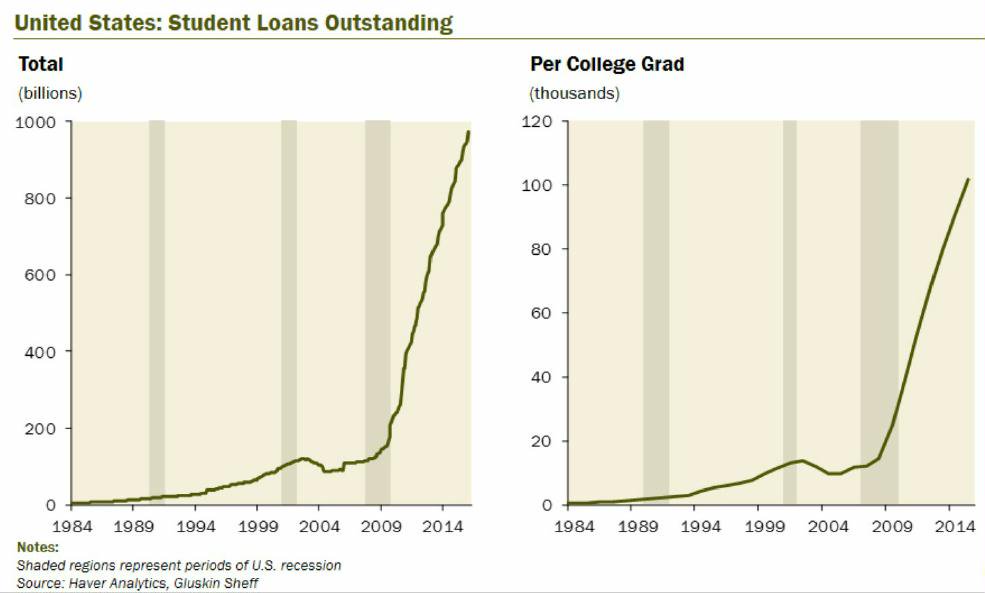
Saw these charts today in a tweet.

CkcJGZfVEAEw239.jpg large

Someone should really show that to Kevin Drum because he just can’t understand why young people wouldn’t want to vote for more neoliberalism and war. The Millennials have perfect lives, according to him.

The charts disagree.

Research

So I’ve been doing research on how certain ideas develop and then dominate the discourse, squeezing out all others. I doubt I’ll ever publish it. It’s just for my own interest. It’s the kind of thing I do all the time in one way or another, but I’m not an academic so no one will care even if the scholarship is excellent, anyway. (Wouldn’t a world without pervasive credentialism be nice?)

But I’ve been skimming through or sometimes reading dozens of older economics books to trace the genesis and development of ideas over time. I classify any economics books over twenty years old as “older” for my purposes.

Noticed this today in The Next Twenty-five Years of Public Choice, Charles K. Rowley, Friedrich Schneider (auth.), Charles K. Rowley, Friedrich Schneider, Robert D. Tollison (eds.) as a chapter title:

“Health care, education and the cost disease: A looming crisis for public choice”

So I read a little. Here’s what I found.

If the citizens of these countries are willing to do what is necessary for the supply of educational, health care and other related services to keep up with the expansion in overall economic output made possible by rising productivity, then, if my analysis is correct, a difficult choice will be required: either ever more of gross national product will have to be channeled through the public sector, with all the problems we know that to entail; or, alternatively, these services will have to be transferred to private enterprise, in fields where private business firms can hope to succeed only if granted an (improbably) immunity from the temptation of unwise governmental interference.

Nice false dichotomy the author has going there.

But it was indeed an accurate prediction and creation of the future; that is exactly what happened. (Of course to some extent it was already occurring, but has greatly accelerated since 1993.)