My friend is I think more pro-immigration than I am. I believe it decreases social cohesion and makes leaders like Trump more likely. I doubt Trump would’ve been able to attain power if the foreign-born population were, say, 5% instead of around 13% in 2016. You might blame racism or nationalism or whatever -ism you’d prefer to cite; I’m not making a normative argument here, but rather observing and speculating about behavior on the ground.
Anyway, she made a good point over here about the foreign-born population percentage during the passage of Social Security legislation and other social welfare state features. I know she’s right about the data because that’s the sort of thing I roughly hold in my head, but I wanted to see how that percentage had varied over time.
I would link to the census data directly, but it seems to have been removed or changed, and I’m lazy, but this seems accurate (sorry, it’s Yglesias).
Here’s the crucial data from that article:
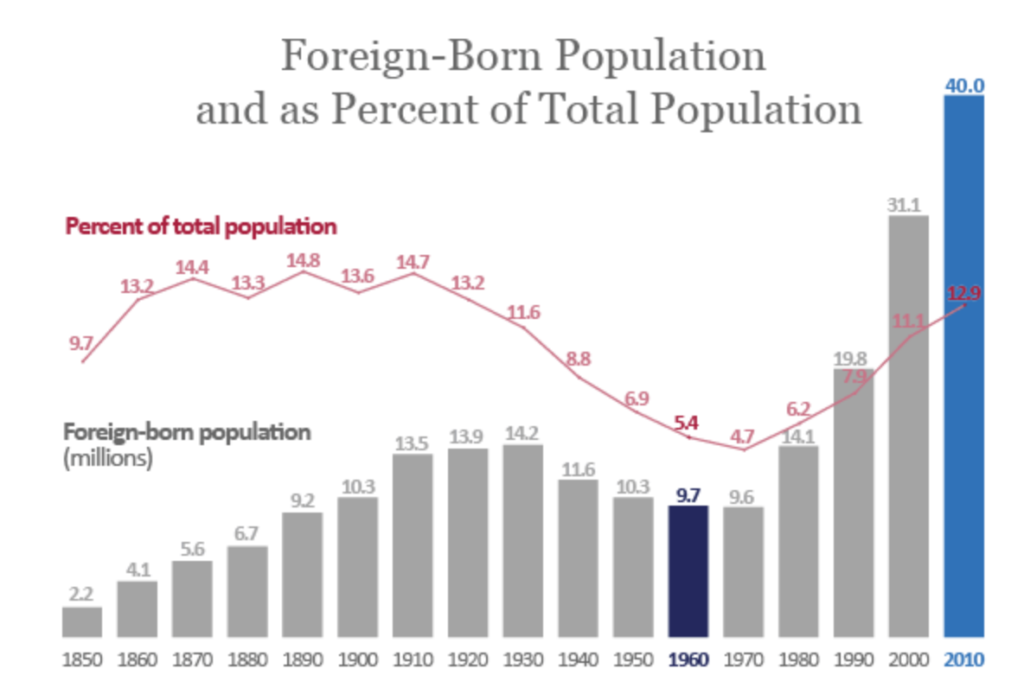
Are there confounding factors? Likely. The number of immigrants as a percentage of the population was on the decline by 1935, when Social Security was first enacted, due to things like this which might have been perceived as turning the tide of immigration. I haven’t studied much about the sociology of that time from this angle, so I don’t know. And perhaps this would’ve been a misperception — it’s unclear to me whether it was that act or the Depression that had more to do with it. Very probably both, to degrees that would be hard to disentangle.
Probably the lesson for me here is that it’s difficult to apply direct relations from history to present times — it’s all too contingent. Studying history is valuable — and one that far more people should do as part of their educations — but it can also reflect like the Mirror of Erised in Harry Potter whatever you want to see.
Historically, though, as foreign-born immigration reaches some high percentage, there is a backlash from the native-born population. I think we’re seeing this again. Now I’m not as convinced that it’ll have such a strong effect on social programs, but I don’t believe history rhymes here strongly enough to tell for sure.
Still, though, I believe the citizens of a country should have a right to determine who should be allowed to live in their country — even if it harms the economy and capital (which reducing immigration mainly harms capital and helps native workers, especially in our current neolib environment). Otherwise, the arguments for a nation-state are much-diminished and without changing society completely and killing neoliberalism, the primary effect of open borders is to make both the country on the receiving and losing end of immigration worse off over time in my opinion, at least as we currently structure our world. Capital wins. (Historically, it has been business that has been hugely pro-immigration. I bet you can’t imagine why.)
Open borders is a nice dream. I like it. I just don’t think it comports with reality as we live it now. Change that reality, maybe I will have a different view.