Big Mind

This post is saying nearly the same thing I attempted to discuss the other day with my own overly-abstruse bit about subsumption into algorithmic nightmare land.

People are now speaking in a way that results directly from the recent moneyballing of all of human existence. They are speaking, that is, algorithmically rather than subjectively, and at this point it is not only the extremely online who are showing the symptoms of this transformation. They are only the vanguard, but, as with vocal fry and other linguistic phenomena, their tics and habits spread soon enough to the inept and the elderly, to the oblivious normies who continue to proclaim that they โ€œdon’t like reading on screens,โ€ or they โ€œprefer an old-fashioned book or newspaper,โ€ as if that were going to stop history from happening.

Historically, we are at an unusual moment that only occurs once every few centuries. There’s no possible path back to the past without massive death and dislocations, but the future also can’t be and won’t be more of the same. We are trapped — or rather, have caught ourselves — in a snare where struggling and thrashing will only make the line grow tighter. Something will have to be given up, to be lost, to keep moving forward. What will it be?

The above is the massive societal-level cogitation occurring now and though most people aren’t aware it’s being contemplated, that doesn’t matter. It still is.

310

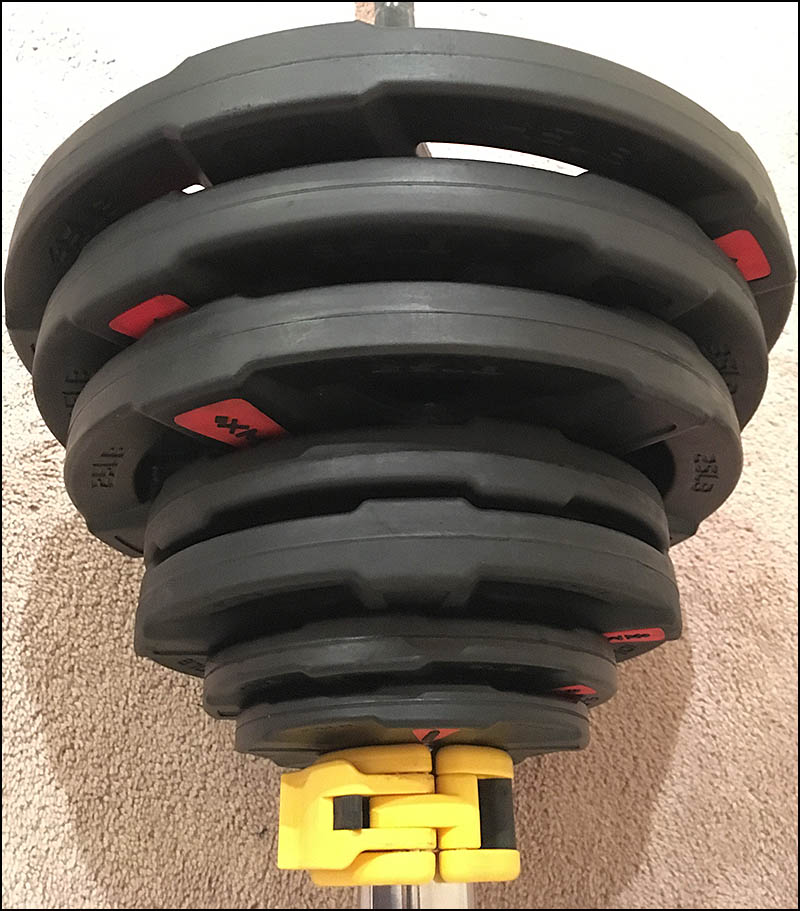
New personal deadlift record of 310 pounds this morning! I am not going to lie, that was a struggle. But I did it.

I am starting to run out of weights to put on the bar. Here’s what the bar looks like on one side loaded for a 310 pound deadlift (none of these are bumper plates):

We do have another set of 45s but they are holding down the squat/pull-up rack so are inconvenient to move.

The Recog

People are having a great deal of trouble recognizing societal changes occurring because we had grown accustomed to direct technological change reconfiguring society so that is where we now look. You know, the arrival of computers, of cell phones and then smart phones — that sort of obvious introduction and adoption of a discrete physical good.

But we’re beyond that now, and that’s what’s causing confusion and the absurd claim that no change is occurring. To return to the ideas of the cybernetic philosophers, we are not being directly affected by the technology itself (contra and also moving beyond McLuhan) but rather the now-exponentially more complex cultural and cerebro-cybernetic reconfigurations that occur and can occur in this ever-expanding realm of informational combinatorial explosion.

So, everywhere everyone is looking for new technology that is not arriving and conclude the world is not changing. But in a sense, we’ve reached a plateau where the tech that used to be physical and available for inspection as an entified object has now been completely subsumed into and instantiated in a virtual realm where its unfolding is less apparent but no less instigative of effects and alterations of the mind and of the world. Rather, it’d be accurate to state that this virtual realm and the world are now selfsame, and that lack of comprehension of this momentous reformation of how we gestate ideas culturally is what is responsible for a large part of the befuddlement.

Way I Am

Alan Jackson’s cover of Merle Haggard’s “The Way I Am” is really excellent. That’s a mood that only country can evoke, and when it does, hot damn, it really does.

Country at its best is not an exercise in nostalgia but rather about yearning for something that you cannot have, or once had and irrevocably lost — that is not only lost but still is so close that it caresses your face with a breath of wind in the middle of the darkest nights. It’s the only musical genre that deals in tragedy and regret and loss credibly and with depth.

In that song you can hear the person that Jackson’s character almost was, wishes he were but is not, feels that he could’ve been if he’d just had a little more of…something. But he didn’t and that’s his fate.

And that mandolin playing is really great. My favorite of any song with mandolin.

The Edge

Knowledge and privilege have different spellings mostly by just serendipity and the vagaries of language drift and variation. Sometimes in language, that’s just way things are. An obsolete valid spelling of “privilege” is in fact “priviledge.”

These two words come from much different places, though. “Privilege” is from Latin by way of Old French while “knowledge” is from Old/Middle English by way of Old High German. This divergent linguistic path might have some influence because “privilege” means basically “private law” and we spell anything to do with that cognate “leg-” as found in “legal” and “legislate.” This probably helped to fix that stem it in the word “privilege.”

The above is just my speculation. Unlike most etymologists on the internet, I will admit it is such because I don’t have the time nor inclination to do all the research that’d be necessary to attempt to determine that with any degree of certainty.

Vegannot

People are not made to eat vegan diets and lots of raw foods. More accurately, we did not evolve that way. We are not gorillas. We can’t eat mostly uncooked leaves and similar. Though we are omnivores, that doesn’t mean we can consume only a tiny and nutritionally-deficient slice of our usually extremely varied diet.

That said, vegetarianism is fine if you’re careful. However, veganism is almost certainly long-term harmful to anyone who sticks to it, and definitely very harmful to children.

PWA

My partner was telling me about progressive web apps the other day and I thought they were applications that monitored what words you used and then got triggered and melted down or closed or something if you used an officially unapproved word.

No, that’s not what they are. But I am sure we’ll get there soon enough.

Middle

“Realistic” literary fiction is just as preposterous as sf or fantasy. Almost no one who has ever lived behaves or speaks like anyone in literary fiction. While it lacks spaceships and aliens, it features humans that might as well be aliens.

Lit fic is the genre that is most delusional, therefore.

Why Open Borders Fail

This is why the idea of open borders is a non-starter and an inevitable failure when put into practice.

Here is an example to illustrate the preceding post. โ€œBut nationalism excluuuuudes!โ€ people moan as if that had to put an end to all discussion of the subject once and for all. They have been schooled to believe that excluding is bad, inclusivity is good, and these are eternal truths that are not to be questioned.

Really, I am almost tempted to quote the entire post because it’s better than the summations I’ve attempted that have relied too much on esoteric explanations rather than more concrete examples. She’s right. We’ve been trained to believe that any form of exclusivity is bad and is “discrimination” when in reality discrimination of self from other is the basis of all life.

I am not using this to justify or apologize for racism or anything obviously harmful. I am observing as she did, though, without a “we” that’s recognized as a discrete entity then there is no possibility of a welfare state, of resisting corporate control or the power of capital — which of course the real goal of “open borders” rhetoric is to destroy not only the welfare state as an actuality but the idea of it altogether as even a possible thing (Margaret Thatcher’s “there is no alternative.”)

The brilliant (in a diabolical way) conflation of racism with any form of nationalism is an ingenious stroke by the forces of capital, though. Really, that’s a true coup because it removes any possibility of criticism or course changes.

Perhaps in 500 years or a thousand years we can expand the “we” to include the entire planet. I don’t think we’re even remotely close, though, and without a nation there is no welfare state, there is no safety net, and open borders will almost certainly be the doom of any and all of those ideas. Which, indeed, is the whole point of the propaganda push in that direction.

Severe Identification

“I feel no nostalgia for our childhood: it was full of violence. Every sort of thing happened, at home and outside, every day, but I donโ€™t recall having ever thought that the life we had there was particularly bad. Life was like that, thatโ€™s all, we grew up with the duty to make it difficult for others before they made it difficult for us. Of course, I would have liked the nice manners that the teacher and the priest preached, but I felt that those ways were not suited to our neighborhood, even if you were a girl. The women fought among themselves more than the men, they pulled each otherโ€™s hair, they hurt each other. To cause pain was a disease. As a child I imagined tiny, almost invisible animals that arrived in the neighborhood at night, they came from the ponds, from the abandoned train cars beyond the embankment, from the stinking grasses called fetienti, from the frogs, the salamanders, the flies, the rocks, the dust, and entered the water and the food and the air, making our mothers, our grandmothers as angry as starving dogs. They were more severely infected than the men, because while men were always getting furious, they calmed down in the end; women, who appeared to be silent, acquiescent, when they were angry flew into a rage that had no end.”

-Elena Ferrante in My Brilliant Friend

Toni

I didn’t write about it at the time because I was too busy with other things, but I think the best overall film performance of 2018 was Toni Colette in Hereditary.

It was in a horror movie, so it’d never be recognized by any awards bodies or anything like that, but Colette is outstanding as the self-tormented woman attempting to prevent a recurrence of the sins of the past…and failing.

The movie itself is good but her performance is perfect.

Circularity

This is the longest shitpost in history.

I just don’t have the time or want to devote the effort to refuting all of it, but essentially it relies on a circular argument, obfuscated Kevin Drum-style very cleverly. That specious argument is that because health care costs more and takes up more of the economy, people pay more. Brilliant insight, bud. You didn’t really need a million graphs to show that.

I can’t believe I bothered to read all that to find some argument that, if stated in simpler terms, would not fool a five-year-old.

Meanwhile, my boss went to an urgent care facility for treatment for a small cut that was bleeding profusely and was charged $2,000 for a five-minute visit. He didn’t even see a doctor.

More seriously, this is a great example of how experts hoodwink you. In fact, it’s one of the best examples I’ve ever seen. The person who wrote this is obviously high IQ — definitely 130 or above. More probably in the 140-160 range. There are not many people who can hang with him and he knows it. This gives him power as the stuff he’s citing as evidence would be incomprehensible or impenetrable without great study to most people. And none of it is “wrong,” viewed alone. That is the danger of high-IQ experts — they can marshal an argument that is subtly twisted, just a bit sinuous and slanted, that it takes another high-IQ person to even understand what they’ve done and how. Well, I can hang and I can tell you that what he’s spewing is pure hooey.

This is what makes expertise particularly under corporate hegemony so very dangerous. Your life is essentially dominated by corporate propaganda subtly perverted from somewhat-valid science and research. Russian propaganda by comparison is obvious and heavy-handed.

There’s a lot else wrong with what he cites. For instance, it classifies health care consumption as some voluntary act rather than a necessity. And this might be true with another way all this is distorted, in that it’s mostly a portrayal of how the rich consume health care in the US. It doesn’t really consider inequality at all — in fact, it deliberately conceals it to get the numbers RCA was looking for.

Furthermore, health care is most likely a Giffen good that is strongly deflationary in nature to the economy as a whole. If you’re looking for why the economy is nearly deflationary despite massive QE and other efforts, health care is where you might want to start.

The RCA contention that the US consumes more healthcare because we are in reality secretly so super-rich is just asinine on its face. And on its ass. It’s just absurd. That’s why it’s obfuscated behind highly technical argumentation and a scad of graphs.

I waste my time reading all of this so you don’t have to.