Today’s first 10 on the playlist. This is the most male first 10 I’ve probably ever listened to, considering I listen to 90% women:
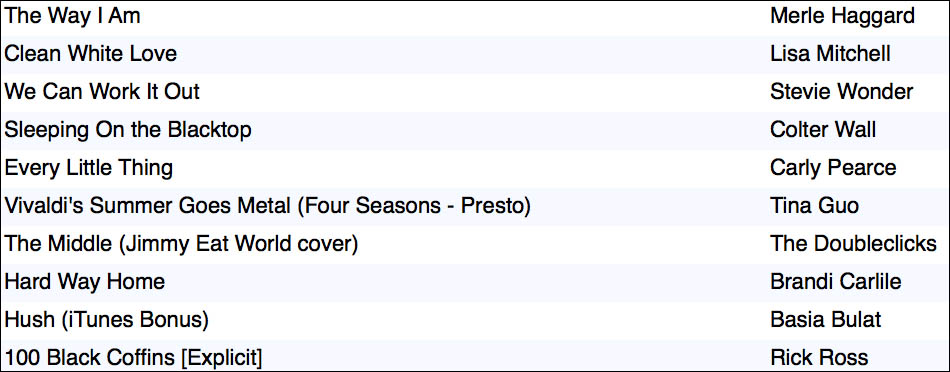
Today’s first 10 on the playlist. This is the most male first 10 I’ve probably ever listened to, considering I listen to 90% women:
The good old days weren’t so good. I don’t think people realize what it was like.
I got my first modem a few years later, and modems at the time were flaky hardware only BARELY supported by single-tasking systems that had never been designed to handle any signal arriving anywhere at a time they did not choose. If your computer didn’t respond fast enough to interrupts, a modem could crash it. If you were running anything that didn’t suspend and resume its business correctly (and most things didn’t because they’d never had to before) or anything that was coded to use the same interrupt, the modem would crash it. If the software on your end ever started taking too long to execute per input character, the modem would fill up the short hardware buffer faster than your software could empty it, and crash it. If you transmitted characters faster than the software running on the remote system could handle them, you’d crash the remote system. There were no error correcting protocols because none of us had the compute power to run them fast enough to avoid a crash at the speeds the modems ran.
That’s why I always laugh when I hear people say things like “Security should’ve been built in from the beginning! That was the mistake!”
Motherfucker, no. Just no. The computers we had back then were so very slow. So slow that you can’t even imagine. I could type significantly faster than my first modem could echo back the characters. I could barely run the one application that I wanted to at the time. There was no CPU or memory for security or for even the application working half the time. If we’d built security in from the beginning, there never would’ve been home computers, BBSes or the internet.
Some games and programs I loaded from cassette tapes (SYSTEM [press enter] – ATOM [press enter] – then press “play” on the cassette deck, wait, then press / then enter) loaded so slowly that I’d start it up, go outside to play for a while, and then 30 minutes later come back — and it still wouldn’t be done.
I think most people under 35ish have no idea just how stupendously slow, balky and resource-limited early home computers were. Then, they seemed like miracles
Now, I can’t believe we ever used them.
It should be a requirement that reviewers at least understand the work they are reviewing. That’s a repeated problem that I run into — not one out of 100 reviewers understood Ex Machina, for instance, and the problem was not with the movie.
Here is another example, this time with the Netflix adaptation of The Haunting of Hill House.
Also, is the reviewer aware that the book is unchanged, just as it was? No books were “mangled” in the process of making the show; it can be read just as it was prior to the series. Also, there were absolutely no jump scares at all in the show. I believe the reviewer might have been watching a completely different series than I observed. (Which is very apropos given the themes of the series itself.)
Here’s the big secret I think the reviewer missed: no one ever left the Red Room of Hill House. The entire Crain family is still there, alive in memories, alive in the house, dead in the world — that’s why the father’s demise is never mentioned, never nodded to, never discussed.
The only way to get a completely happy ending in this life is to never engage the world — and in the context of the show, how does one never engage the world?
Exactly.
The way is to be digested by Hill House. The Crains all died there, and are together, perhaps even happy, in their memories, in their fantasies, in the ever-present timeless phantasmagorium of Hill House.
“Adam Smith, it was true, treated material wealth as a separate field of study; to have done so with a great sense of realism made him the founder of a new science, economics. For all that, wealth was to him merely an aspect of the life of the community, to the purposes of which it remained subordinate; it was an appurtenance of the nations struggling for survival in history and could not be dissociated from them. […] There is no intimation in his work that the economic interests of the capitalists laid down the law to society; no intimation that they were the secular spokesmen of the divine providence which governed the economic world as a separate entity. The economic sphere, with him, is not yet subject to laws of its own that provide us with a standard of good and evil.”
–Karl Polanyi in “The Great Transformation”
In other words, Smith did not see economics and markets as something separate from human affairs and human purposes; unlike modern economists he did not equate economic “law” with natural laws and likely would’ve thought it absurd to hold a demand curve equivalent with the law of gravity.
One must understand, then, that the supposed commensurate status of economic precepts and suppositions with naturally-occurring laws is an ideology, and an effective one at that.
Scientists Say Ocean Circulation Is Slowing. Here’s Why You Should Care.
Climate change is going to be a lot of “small” disasters happening all at once that add up to something much larger. It’s dispiriting that even many on the left are so clueless about their utter and complete reliance on the biotic and non-biotic processes. The effects will also be multiplicative, not additive as most people imagine.
I single out the left as that is my side, and most of them are almost as ignorant on all of this as the most ardent climate change deniers. The vast majority have no idea at all about and scoff at the mention of how dependent they are on ecosystem services, and believe we can geo-engineer or tech our way into some better state.
I don’t think this is true at all — at least without precipitating other major disasters as bad if not worse than climate change.
The only things Russiagate accomplished were expanding the military, manufacturing consent for internet censorship, smearing all dissenting political speech as Russian psyops, and making everyone dumber. Everyone who helped advance it should be mocked and marginalized forever. https://t.co/bhSIbnO7Zg
— Caitlin Johnstone (@caitoz) October 19, 2018
That pretty much says all that needs to be said about that whole mess.