Fast Approach

Intermittent fasting is not an eating disorder. It’s certainly a lot healthier than the routine binging that most seem to advocate as FA garbage has taken over the discourse.

Tell you what. Give me 20 years, one group that intermittently or even routinely fasts and the other that eats the FA-approved diet (intuitive eating BS). We’ll see who is healthier and who has the higher mortality rate at the end of all that. Hint: it won’t be the ones who need a Burger King stop every three miles.

There must be a lot of food company money helping to amplify these FA messages; otherwise I don’t think they’d have such reach and dominate the conversation so completely. That just can’t happen without someone contributing a lot of cash.

Anything that’s not stuffing down 5,000 calories a day being portrayed as an eating disorder just must have a big pile of corporate cheddar (I would say “cabbage,” but FA types don’t actually eat cabbage) behind it. Wish I had the time and the dedication to investigate it as there must be a good story there.

Crab

In the US especially. You can be “wealthy” here until you get cancer, then it can be $2 million gone just like that. I’d only count someone wealthy in this country if two family members can survive having cancer for 3-4 years, and not be flat broke at the end of it all. Otherwise, you are just conditionally wealthy until some medical tragedy occurs.

Body Talk

Sorry, guys, you canโ€™t be an actor and moan about body image.

This not very nuanced, but I mostly agree. Though I do appreciate if everyone in a film or TV show isn’t ridiculously beautiful, as it’s not realistic and is distracting.

But come on. You literally took a job where other people are paying to look at you. I’m already hitting the fucking (home) gym, but I’d be hitting it even harder were my job to be observed by millions of strangers.

This is just performative wokeness, for the most part, when actors say things like this and still get fit anyway.

HG (not silver)

I still have trouble comprehending the fact that many people browse the internet on smartphones because it works like such hot garbage compared to using a real computer. Propaganda works, and convincing people something much worse is “more convenient” because it is better for advertising and control has been astoundingly successful.

Contra Drum

What puzzles me about Drum is that it’s so easy to find and use the relevant data. He must think his readers are pure idiots. And I guess he’s right. For instance, this article uses relevant data.

They find that “inflation-adjusted rents have increased by ~64% since 1960.” This is less than I’d found, but then again it matters how you examine the data (and where you look). And:

Next, we looked at cost-burden rates by household income quintile. Renters with incomes in the lowest 20% have had cost-burden rates greater than 70% since the 1970s, and affordability has continued to decline in recent years. Among renters in the lower middle bracket (making up to $41,186 a year), however, the increase in cost-burden rates has been significant, with an increase of 22% since the year 2000. Renters in other income brackets have fared better, but cost-burden rates have risen across the board.

Drum is not an expert on anything (and it shows), but people treat him like one. And he’s smart enough to dupe his readers with pretty graphs that look correct but contain misapplied or misunderstood data. That’s what makes him so rhetorically dangerous.

This article is also decent.

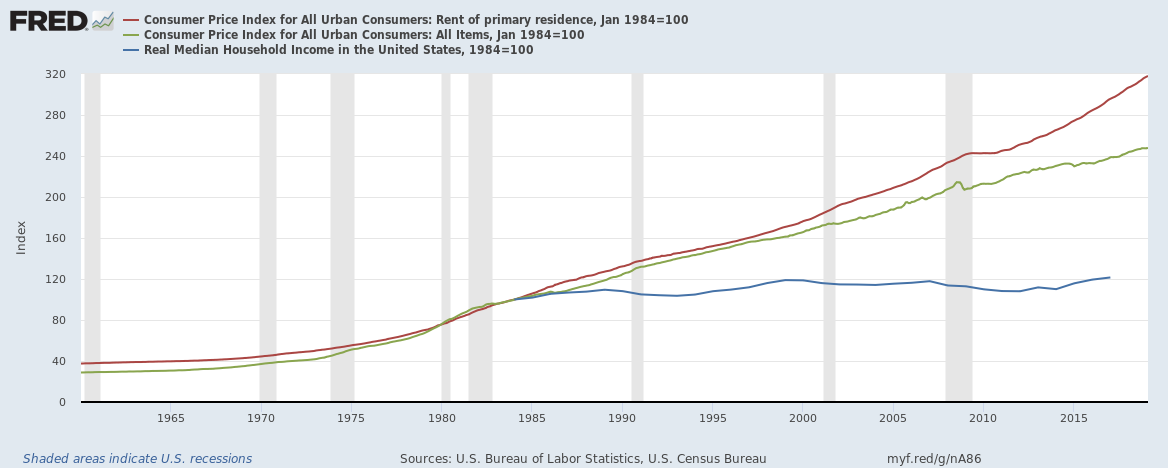
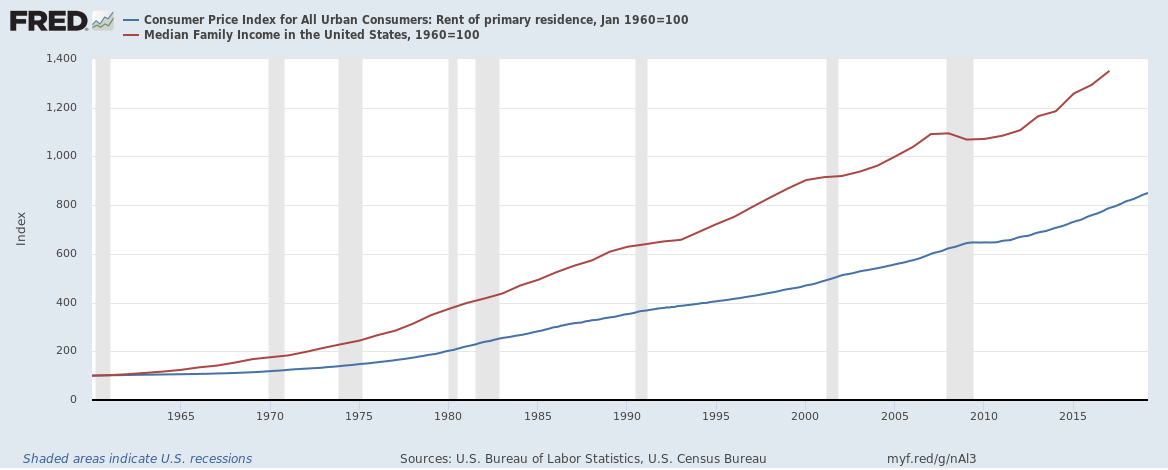
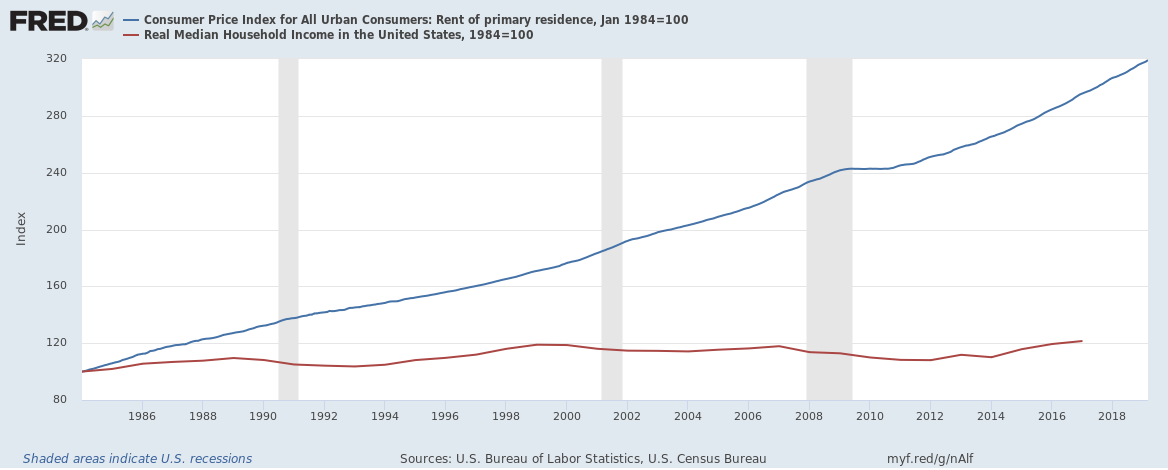
After I attempted to reproduce Drum’s data and could not, I finally figured out one of the tricks Drum pulled on his first graph, the one that compares rent of primary residence to median income. He’s using median family income and not median household income. Median family income only includes people who are related to one another and does not include anyone living alone (about 25% of the population). The difference, obviously, is significant. Because it changes the composition so much it means that median family income is about 30% higher than median household income, which is mostly enough to erase the very obvious and occurring-in-the-real-world divergence of rent from median income.

Needless to say, median household income is more relevant and more broad than Drum’s bullshit use of median family income (a trick he has pulled before). Using median family income is severely misleading for a whole host of reasons.

Here’s the two compared. First, Drum’s BS data, using family income:

Fredgraph

And here’s household income, the better measure (unfortunately this latter series only starts in 1984):

Fredgraph 1

Turns out you can get a lot of mileage out of mis-examining data. Drum does it frequently, and it does take some digging to figure out how he does it, exactly.

Most Revealing

There’s already too much in the post below, but I think this is the most revealing graph of all:

I produced it with data going back to 1960, though the real median household income series only starts in 1984. Still, it shows the dramatic increase in rent compared to the almost-nonexistent increase in real median income comparatively.

Date Used Incorrectly

This is why I despise anything Kevin Drum does relating to the economy. It’s always so shoddy and disingenuous. Could this be any more misleading?

This is a terrible way of looking at the data because, first, using the median tells nothing really about the range, which has widened greatly over the last 40 years. Second, the CPI and housing-specific CPI doesn’t in any way measure the composition of those in the bucket. How many people leave an urban area because the rent is too high, or are forced to commute for hours, etc.? It is a lot. There are other problems, too — in fact, too many to list so I will call a halt there and get to the data.

Here’s what it looks like when you examine the data in any sane way.

First, for some baseline. The top 20 MSAs in the US have approximately 122 million people dwelling in them. In nearly all of them (save Detroit), rent has increased much more quickly than the median income. Those 20 are 40% of the US population alone, so yes they are very important.

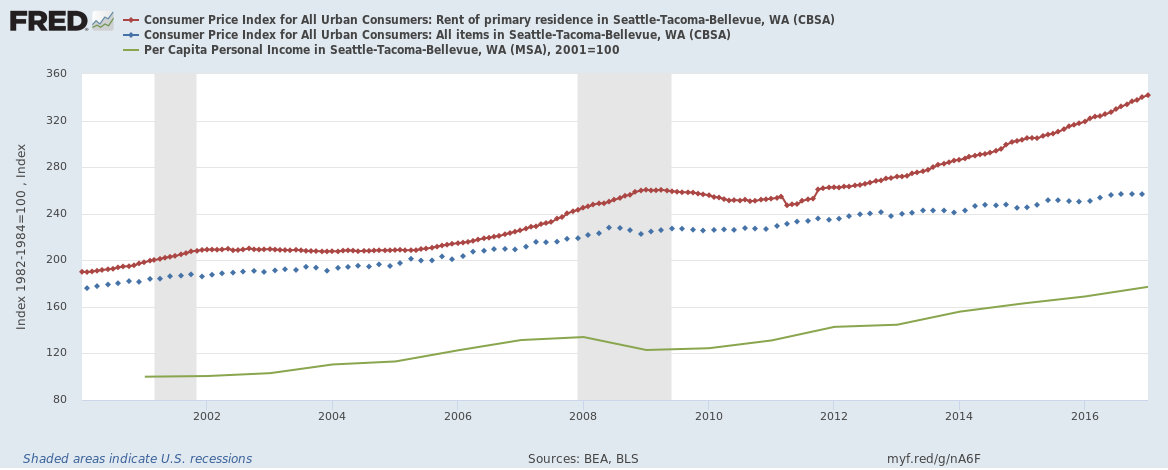
For instance, the Seattle-Tacoma-Bellevue MSA:
Fredgraph seattle

Notice how the red line, the CPI for rent, goes up far faster than the green line, the per capita personal income? And this doesn’t count, again, all the people who’ve left the area because rent became too expensive (which would be many, many).

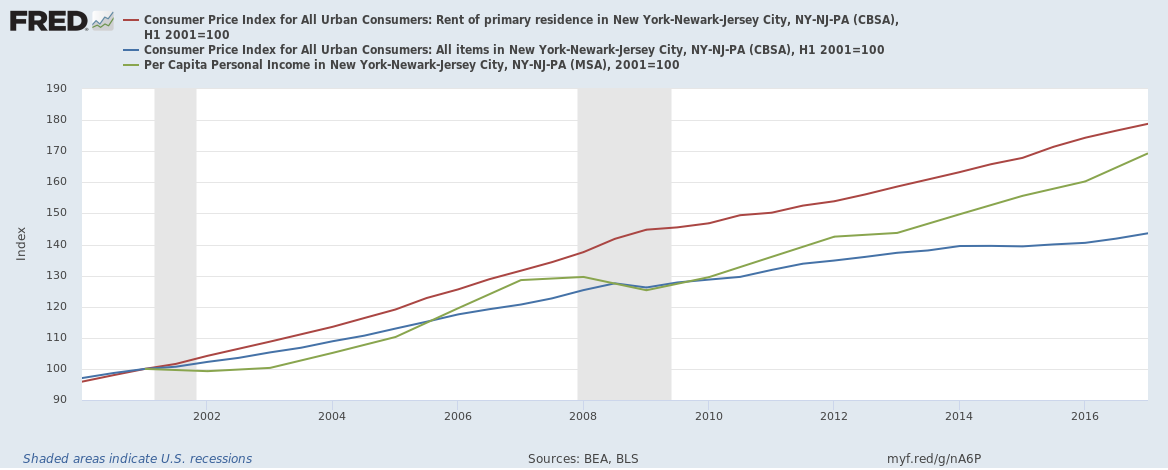
And here’s similar for the NYC MSA:
Fredgraph NYC area

It’s not as bad, but it’d look a lot worse I bet if compositional effects could be taken into account.

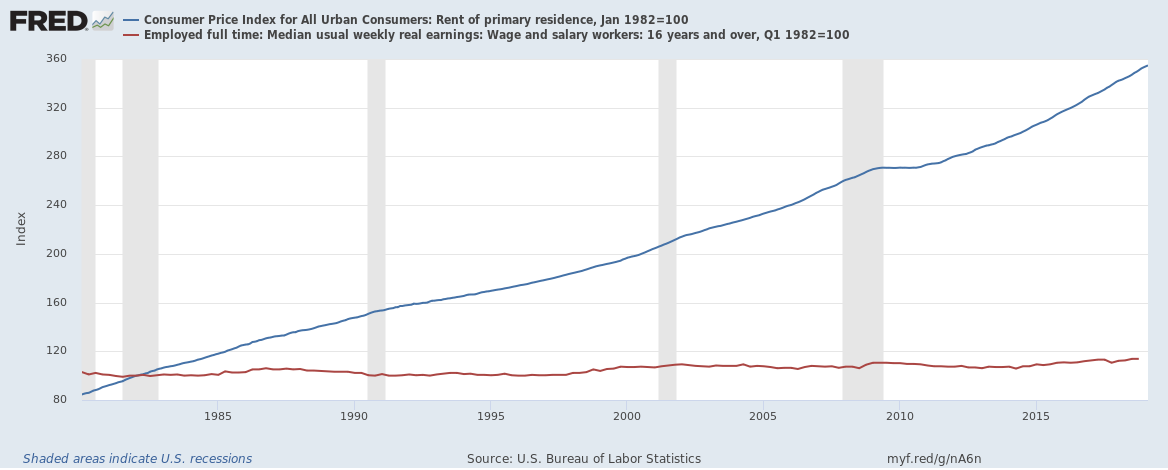
And here’s a comparison of CPI for rent of primary residence versus the median weekly real earnings of all workers, age 16 and over, all indexed to 100 in 1982 so it’s easier to compare.
Fredgraph

Well, that looks a little worrying, does it not? In other words, if having it written out is easier than graphs, real earnings broadly have gone almost nowhere — up maybe 15% — and rents have gone up 240% since 1982. I think I see a problem.

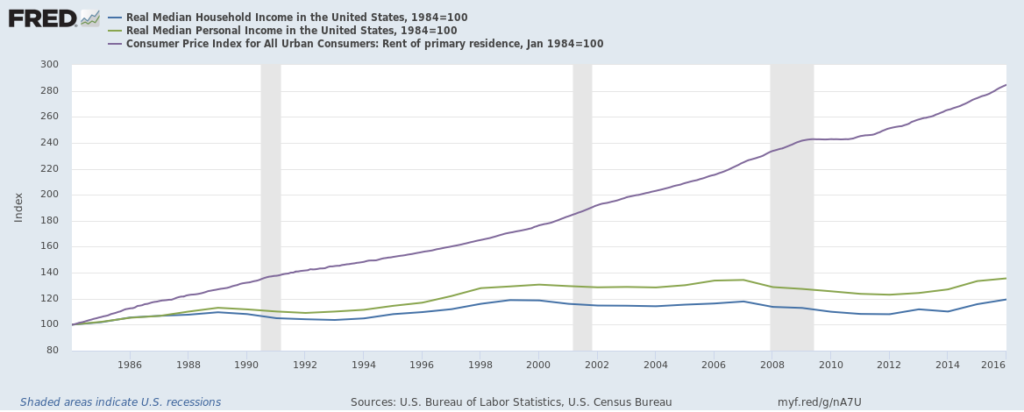
Updated to add this graph, because per capita income can be misleading in its own way, but too lazy to change the colors to match (tired of doing someone else’s homework):
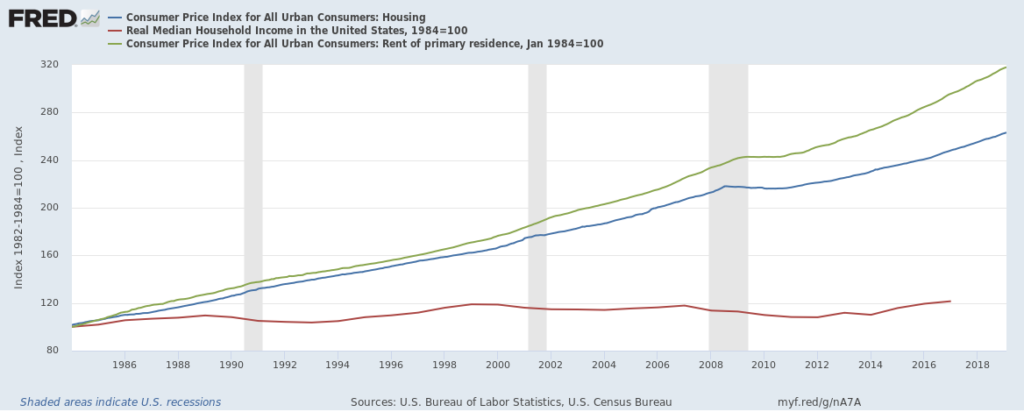
Updated to add another graph to show how much rent has increased even if you use median income measures, really shows how much rent shot up, using data Drum was allegedly using (though I can’t seem to repro his rosy results, though I didn’t try that hard):
Anything of Drum’s that you see relating to the economy, examine closely and it’s just safer to reflexively disbelieve. His agenda is to pretend that everything is tickety-boo and thus no changes at all need to be made — it’s the ever-maddening cry of the centrist in graphs and misleading data: “Nothing is possible!”
Parsing

Indeed. The most logical thing is for nothing at all to exist. Satisfies the principle of parsimony nicely, in that non-existence is maximally parsimonious.

Given that the null hypothesis of non-existence is rather firmly disproven, one then must discard logic as an explanation from the outset.

RCE

I always wondered about RCE exploits on wireless devices like this and expected they had terrible security. Well, they do. That’s one of the reasons I don’t use them, just that suspicion alone.

Xious

I have never experienced anxiety. I don’t say that to brag; I just don’t have that setting at all. I have no idea what it could be like, or even an easy ability to identify it in others. It just doesn’t exist for me.

Feel very luck about that, really! Don’t want it, don’t need it.

Like Polo

I’ve wondered about this often, too. Companies absolutely do not maximize profits. This is 100% false. Many if not most are more interested in punishing their workers for no substantive reason than they are in maximizing profits.

Why this is so pervasive, and why no company seems to be able to deviate from this impasse, I have no certainty about. It seems to me that something is either deficient in human nature itself (most likely) or that my model is wrong somewhere. However, having worked in quite a few corporations, it just appears that people and MBA types in particular are more interested in ensuring predictability and obeisance than profits. Why this is exactly, I don’t know.

I think a large part of it is that MBA types and the rich actually enjoy exerting adversarial control and practicing petty (and worse) forms of cruelty. It’s a hobby, it’s something worth foregoing some profit and some gains to enjoy this sport of the powerful.

Registart

I’ve registered to vote twice in Florida, and both times I cannot be found as a registered voter. I don’t have any felony convictions, etc., but registering to vote never goes through for unknown reasons. (Florida is my state of residence.)

Don’t think I will try any more; seems pointless. Voter suppression works!

Usury

I’m not much into conspiracy theories, but this is something I’ve wondered about often. I do think more than a few lenders and corporations had this as an explicit goal, because it was an obvious outcome. (The “who could have known?” narrative is extremely, extremely false. Many people knew and were in a position to do something with this knowledge).

Also I believe this was the case because throughout history, the objective of many if not most lenders has been to saddle populations with usurious and unpayable debts with the explicit goal being to seize the property once the recipients of credit are inevitably unable to pay.

There is little new under the sun. Why would this be different in 2008 or now?

Exclusion

Read this whole thread. It’s worth it. (Click on date-time stamp to go to thread.)

It coincides with a lot of what I’ve been thinking about lately regarding the social construction of reality and how there is no such thing as objective measurement of any social aspect of life. It just can’t exist.