Secure

Them: Our Windows installs are totally secure — we’ve got them totally locked down.

Me: Watch this! *uses some minor privilege escalation bug that’s been in Windows since the Stone Age*

Them: *Face falls off and slides onto the floor as they realize I’ve owned the machine and thus their network in about five mouse clicks*

I love doing stuff like that.

Revelation Space

Revelation space is foreshortened by the cumulative knowledge of humanity, in some sort of Jungian collective unconscious imbued into us by cultural exposure. Thus, we now search for revelation in unaccommodating places and, finding nothing, create our own invalid territories of epiphany, where we discover the fraudulence of our own minds. Anti-vaxxers and global climate change deniers are born here, as is the “well, actually” bro.

There is no escape from this constraint, as the constraint itself is freedom from ignorance — retreating from that is only to discover ignorance again and revel in the regression. The conflict, though, still remains and the psyche is never unburdened and one can never return to the time of unknowing.

Ance Not In Their Pants

Hypocrites, all. No one really very much wants the system to change. They got theirs, that’s what matters. For all the sanctimony I see on Twitter, didn’t see any activism at all during the Obama administration.

The resistance is a sham. If anyone gave a fuck, they’d give it too when Trump’s not in power. Wankers.

Cosa Nostra

This is what I think people don’t understand: even if you gain something from it, extortionate items like health care and higher education are still a racket. This is true even if many of the educators and health care providers are “honest.” As with not understanding risk very well, many people have real trouble with shades of gray and accepting that the world is not completely Manichean in nature.

For instance, the health care system and higher education share many traits with the Mafia. Something that most people don’t realize is that many people didn’t know they were even working for a criminal organization. They sat in offices, worked in factories, drove taxis. All those businesses — many but not all fronts — were legitimate undertakings operating legally as far as anyone could see. But at one point in NYC and Chicago, tens of thousands of people were employed by the largest criminal organization ever to exist in the world.

Health care and higher education are similar, due to who controls them and their methods.

I won’t argue that higher education and health care in the US are as criminal as the Mafia. Obviously, that’s absurd. But I do argue that they are also definitionally criminal in nature: their methods are coercive, they swindle their own customers freely, and they offer no guarantees of quality while being very punitive if you stray. In short, they are legally-sanctioned but de facto criminal enterprises in a moral if not legal sense.

The Point

I think I can understand why liberals and lefties hate Arnade so much. It’s because Arnade and his book destroy the notion that it’s innate and unalterable racism that is responsible for all the problems of the world — that in fact, many of the decisions made by the liberal meritocrats are directly responsible for economic injustice, impoverishment of entire communities, and the rise of Trump.

No one likes the finger of blame pointed at them, especially when the attribution of culpability is accurate.

Sure, the left has also done much to help. But it’s also done much to hurt, especially lately, and despite its claim to not believe in genetic…anything, nearly, a large majority of the left seems to have concluded that some people are genetically racist and genetically stupid, and just too half-witted to up and leave their towns, their families, their support networks to go work in some overcrowded place with absurd rent costs and no support networks.

Detesting Arnade and the gall of his actually talking to people makes perfect sense in this light. No one likes to be told their “help” and their spreadsheets are worthless. Thus, you see the people actually making a difference in the world like Arnade being pilloried, while those who confirm all the liberal worst tendencies like Buttiegieg, and who actively make the world worse, are lauded.

NWO

That is, in the main, Kevin Drum’s entire ethos (and that of most Boomer and Gen X types). Change nothing, it’s all good, just let me die believing my bullshit.

Again and Again

Here goes fucking Kevin Drum again. Claims that “Millennial Debt Is Actually Quite Low.”

Let’s do some basic thinking here — something Drum seems absolutely incapable of. Say you have a certain amount of income. Only so much of it can go to debt servicing, because you still need to pay rent, for health care, for food.

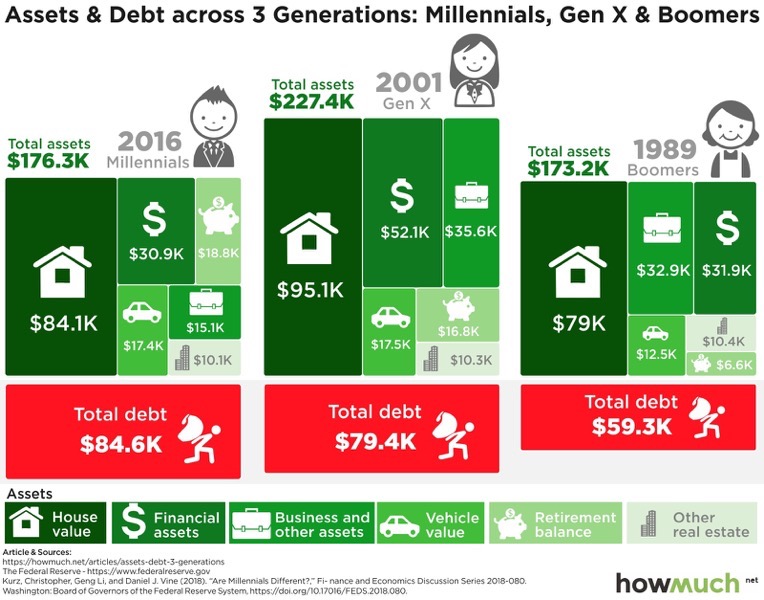
What happens when your debt composition changes dramatically to student loans over time, while for those without a college education, incomes are falling? And it also happens that the necessities of life such as housing, health care and education are getting vastly more expensive. Meanwhile, student debt takes up a large portion of the millennial possible debt vs. income ratio.

The average student loan debt per borrower in 1989 โ€” when boomers were in their 20s and 30s โ€” was less than $2,000, according to the Urban Institute. In 2015-16, bachelorโ€™s degree recipients who borrowed money graduated with an average of $28,400 in student loan debt, according to the College Board.

More than 40% of millennials report having student loan debt compared with 13% of boomers, according to a study by Aon Hewitt.

(I am not sure if the 1989 number is inflation-adjusted or not. I think it probably is.)

And then, for instance, you end up with something like this:

Assets debt 3 generations cf96

Also, “Millennials are $1 trillion in debt โ€” more than any other generation in history.” The headline is a bit sensationalist, but it’s not wrong.

Also:

A study from the Federal Reserve Board has found that โ€œthe average student loan balance for millennials in 2017 was more than double the average loan balance for Generation X members in 2004.โ€

This, it was far more than the Baby Boomer’s student loans (about three times). That’s, of course, going back to debt composition and debt servicing we were considering a bit prior. Also, to address a variety of Drum’s stupid-ass points, check out this Fed Report that fucking Drum should read rather than skimming worthless graphs. And I quote:

We showed that millennials do have lower real incomes than members of earlier generations when they were at similar ages, and millennials also appear to have accumulated fewer assets. The comparisons for debt are somewhat mixed, but it seems fair to conclude that millennials have levels of real debt that are about the same as those of members of Generation X when they were young and more than those of the baby boomers. These balance sheet comparisons likely reflect, in part, the unfavorable labor and credit markets conditions that prevailed during the 2007โ€“09 recession, some of which had prolonged effects.

That must be considered, as I mentioned earlier, vs. composition of both expenses and debt. Thus, While incomes have increased for millennials, many significant economic expenses, such as the cost of buying a home and college tuition, have increased at a faster rate.

Also, here’s some more relevant info:

Key study takeaways

Rent costs: Millennials pay the highest rents when entering the workforce, with a 2017 average of $1,358. By comparison, Gen-Xers paid just $850 (in todayโ€™s dollars) in rent per month at the same life stage, and the Silent Generation paid under $500.

Homeownership: Millennials buying their first homes today will pay 39% more than baby boomers taking the same step in the 1980s.

Getting a degree:
When millennials were born, tuition at public 4-year colleges was just $3,190 per year (adjusted for inflation). By the time they grew up and enrolled in college, tuition rose 213% to todayโ€™s cost of $9,970 per year.

Earning more: Millennials and other generations have benefitted from a 67% rise in wages since 1970. However, these gains have not been enough to keep up with ever-inflating living costs. Rent, home prices, and college costs have all increased faster than incomes in the U.S.

I don’t know what Drum’s problem is — deeply afraid of change and his house price falling a bit, I’d guess. Still, why lie? Why distort so much that is obvious, when valid information is easy to find? It’s a waste of everyone’s time and perhaps that’s the point. The more chaff you can spew the less chance anything has of changing.

As for me, I guess I will keep taking this doofus down until it’s not fun anymore.

Resist the Tentacles

Had a dream that I was on a team in charge of fighting the return of Cthulhu. As we strode out to do battle for the last time I announced, “I’m going back for my sword.”

A woman on my team said, “Do you even know how to use a sword, and how is that going to help in fighting an extradimensional horror like Cthulhu?”

I said, “No, not really, but if I am going to die by having my mind pulverized by an unutterable terror from outside the universe, I am going to look cool as all hell while doing it.”

So, pretty much like me in real life.

Everyone, Nearly

People have a truly terrible understanding of risk and its mitigation, particularly risks with catastrophic consequences that unfold slowly.

Yes, I am thinking about climate change but it is true of any similar risk: drinking, smoking, caloric intake, etc.

How much money or time should you spend if the risk is catastrophic but only has a 1/10 of 1% chance of occurring? If it’s truly catastrophic, then you’d spend much, much more than 1/10 of 1% of your budget (if you don’t believe me, ask literally any insurance actuary).

So let’s think about it like an actuary would, just for fun.

First, check this report. Here are some highlights.

The value at risk to manageable assets from climate change calculated in this report is US$4.2trn, in present value terms

The tail risks are more extreme; 6ยฐC of warming could lead to a present value loss worth US$13.8trn, using private-sector discount rates.

From the public-sector perspective, 6ยฐC of warming represents present value losses worth US$43trnโ€”30% of the entire stock of the worldโ€™s manageable assets.

Remember, there is no “average” climate change but there is potential existential risk — so this is not a normal actuarial calculation! It’s more appropriate to consider tail risk here, with some premia thrown in for existential risk. Again, not a normal calculation, so what do insurance companies do when insurance is hard to calculate? That’s right, it gets much more expensive. Ever checked Lloyd’s rates? I have, and oh boy. In other words, to put it in more formal insurance terms, the actuarial assumptions here are extremely shaky so the price goes up.

However, to get an idea, and to avoid worthless disputation, we’ll just use basic insurance ratios only. Going simple here is better since many of the risks, though relatively high (in both magnitude and likelihood) are nearly impossible to estimate. (And I know already that the “simple” scenario will still be very expensive.)

I’m skipping over a lot here, but insurance companies calculate something called “Loss Cost” or as its sometimes called, “Pure Premium.” This is the measure of the average loss per exposure. Further, the premium (what you pay) is calculated using this number. However, given the “you” is “all civilization” these two in our case will be the same.

When you do this calculation with global climate change, it produces some very funny numbers indeed. Because when insurance companies calculate loss cost, the equation is “losses, divided by number of exposures.” But what happens when you do this in the case of climate change? The loss cost is $43 trillion (remember, insurance premia definitionally are based on potential worst-case losses, not actual) and $43 trillion divided by 1 exposure is…$43 trillion.

So we’ve come ’round to the same number we started with, using standard insurance actuarial calculations. Huh. Fancy that.

(In reality, there is a further calculation that is done in insurance that determines the actual paid premium [sort of] by dividing the premium by number of exposures, but that will be the same here as well.)

A better way to think about this, though, given both the simple truth and absurd results I mentioned above is how much should each human on earth pay as a “premium” to forestall, mitigate, or prevent the tail risk of $43 trillion of losses? And that calculation comes out to be about $600 for every woman, man and child on the planet.

Given that a significant percentage of the population doesn’t and never will have that much cash, and is less responsible for global warming than others, how about the richest 500 million? What’s their premium?

It’d be about $8,600.

So that’s how much every well-off person in the world should be paying to “insure” against climate change: about $8,600, In reality, as already mentioned it should be higher as there is no actuarial past data, mostly, to establish a true risk profile and the risk is potentially infinite (existential). However, as also mentioned, I chose to use very simple and well-accepted insurance industry calculations for exposure to determine my premium as those are much harder to object to for any quibblers.
Noise Poise

I remember. My brain still sometimes interprets non-noisy computers as “broken” as that’s what any computer from 1980-2000 or so would’ve been. Modems screeching, hard drives yammering, chattering and seeking, CD-ROMs winding up like a UH-1 Huey, floppy drives grinding and groaning — a working computer to me is a noisy one.

Without question, I prefer the quietude of today’s machines. However, I grew up on computers that were a complete chaotic cacophony of sonic assaults so it will always be embedded somewhere in the back of my brain.

Net Weak

Oh, that’s great. Love it. Because it’s not just the users who say, “The entire network is down” when in fact it’s almost never the network. Screaming this also are other sysadmins, management, etc., when an incident occurs.

Hint: It’s almost never the network. In my experience, it’s a network issue about 5% of the time. The rest of the time it’s either not a real incident, it’s related to some hardware failure, it’s just user error, or someone has pushed bad code.

But people always, always blame the network first and then you have to waste valuable time proving it’s not.