Prone

I am going insane. This company will lose $10bn this year! Generative AI has peaked! There isn’t a sustainable business model, and the products are mediocre and error prone and don’t even do anything cool despite costing billions and accelerating climate change and stealing everybody’s artwork!

[image or embed]

โ€” Ed Zitron (@edzitron.com) January 22, 2025 at 6:03 PM

I like Ed, but this is a clueless take. He’s not thinking predatorily enough, like an MBA would. The point of GenAI is to eventually replace workers, not to be these little toys we have now. The MBAs simply DO NOT CARE if AI does not do work that is as of the quality that a human can do. If a GenAI costs 1/20 the price and does work that’s only 1/4 as good — that is still a net win. In MBA thinking, anyway.

Ed is wrong, wrong, wrong. โ€œMediocre and error prone” at a low price is just fine in capitalism. Preferred, even, if it never talks back, never demands higher wages and has no actual human needs.

Understand this or you understand nothing.

Home Slice

In broad outline, I agree. Without that home-building gap Trump would’ve never had a chance. Building enough housing still would not have solved that many good jobs were shipped to Mexico and China and never replaced — but an adequate home supply would’ve made us far less likely to go off the rails as a country.

It wasn’t just the effects of 2008 that caused this gap. Around then, NIMBYs really ramped up their bullshit. In a very real sense NIMBYs might ultimately cause the destruction of the United States more than any other single factor.

Unins

Is the World Becoming Uninsurable?

As tail risks increase greatly, insurance costs should rise very non-linearly because how actuarial risk calcs work. Basically, to simplify the work of actuaries greatly, a 10x or greater increase in tail risk1 means that most areas are no longer insurable.

We’ve reached that now with recent disasters in the North Carolina and with the LA fires.

Soon, I’d expect many places to have no insurance available at any price. And yes, that has everything to do with climate change.

  1. Rather, the unpredictability of likely tail risk costs.

Homer

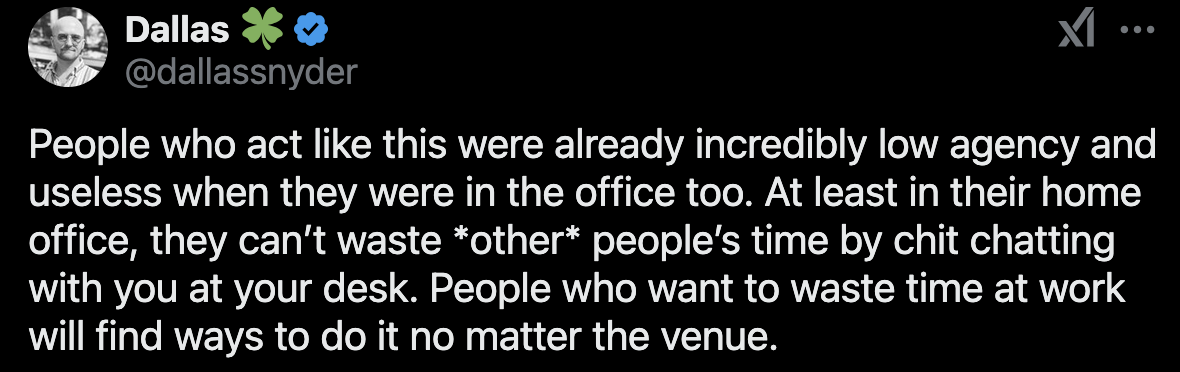
This is bullshit, because the actual truth is that the people who can’t work from home effectively are the very same people who didn’t do any work in the office. Invariably, they are the ones who spent hours wandering around the building, chitchatting, gladhanding, disturbing everyone else and pretending they were busy while doing absolutely nothing.

All the MBA types who hate WFH secretly know that is true, but don’t care — because they want work to be both a social club and a panopticon where they can keep an eye on their slaves. And a lot of them are just morons who think that butts in seats == productivity. Certainly cannot discount that many of them are just really, really dumb.

If your people are not productive working from home, you have a management problem. It’s not a WFH problem.

On average, I produce about 2-3x as much working from home as I do in an office — both because I work longer hours and I can do my actual work.

I will never work an office job again. Not for any money.

Eff Ic

This comment is exactly right.

I am old enough to remember when companies had large training departments, there was an actual training period, and most departments were adequately staffed. That started disappearing (along with pensions) during the 2001 recession and then all of that was completely eliminated in the name of “efficiency” during and after the Great Recession. People younger than 42 or so cannot remember how it used to be. But it was better.

Now, 10-20 job roles are collapsed into one or eliminated altogether. For instance, Microsoft doesn’t even have QA anymore. And it shows. The developers and to a larger extent the users are expected to handle this.

This same process happened across industries as MBAs took over, corporations concentrated on stock buybacks and enriching execs and shareholders short-term rather than any longer term sustainability. And we see how that played out.

The Problem Is Not Cost

Yup. And it’d only cost around $100 billion to fill the desert1 with enough solar panels and batteries to power the entire United States year-round forever.

The problem is not cost. Nor even what is possible. The problem is will. We could do so much more than we have done. And we should. The future does not belong to faint-hearted, anemic degrowthers cowering before the god of lost causes and reveling in their prostrate servility. The degrowthers claim that tech will not allow us to survive what is coming. But that is completely wrong. In fact, it is the only thing that will.

We undertake insanely ambitious projects or we die. It’s as simple as that.

As I’ve said before, we must become the gods that we pretend to be.

  1. Or somewhere, if the desert is gone.

Ridge-id

NIMBYs have made all of us significantly poorer compared to what could have been. One economist estimated that GDP would be 30% higher without NIMBY evil. I think that is probably correct, though I suspect the real number could be as much as 50% larger if we’d crushed NIMBYs when we should have (during the 1970s). Preventing people from living where productive work and economic prosperity is located has all sorts of follow-on effects that are difficult to account for.

Areas with year-round good weather like San Diego and its immediate surroundings should probably have a population of 20+ million.

Slabor

Indian CEO took over a firm, booted out founders, hired Indians.

This is incredibly common and incredibly racist. In the liberal world, you’re not allowed to say anything about this. But the truth is a lot of Indian people will only hire from their own country and even worse, their own caste.

It’s one of the many reasons I do not support the current H1B program and think it should be dissolved.

Bye to Best

We find that these firms experience abnormally high employee turnover following RTO mandates. The increase in turnover rates is more pronounced for female employees, more senior employees, and more skilled employees.

It’s no surprise that the best and more capable employees leave when RTO mandates occur. I would quit immediately if I were forced back into any office and will never work for a company that requires office attendance again. It is so insanely unproductive. And to be perfectly frank, compared to my peers I am somewhere between 3-20x as productive as the average employee in my career field. Lose me and you’re going to have a hire a lot more people1.

Good to see some research around this.

  1. I am currently working on a major project alone that in most firms would be done by 8-10 people, for instance, all while still doing my main job.

Gothica

This is funny, and true, but when malls decided they were for Directly Observable CapitalismTM only and not for any hanging around, being social and having some sort of community function they became much more boring. And, funnily enough, much less profitable. This shows that social control trumps profit, as I’ve long posited. It was more important to restrict social spaces than it was to make money. The tale everyone spins is that the internet killed malls. But that’s not really true. It was the ownership class deciding that the interests of fuddy-duddies who didn’t actually spend that much money were more important than those who purchased the most but were younger and less socially powerful.

I could not find it again, but think it was on Reddit — anyway, there was a story someone told about they and their 18-22ish-year-old friends hanging around at a Starbucks nearly every day, not being disruptive, just chilling. Then out of nowhere, the owner asked them to leave and not come back. So they did. Turned out this group and their friends who would drop by also sometimes were responsible for something like 30% of the store’s sales alone. The drop in orders was so severe that when the owner saw one of them again, he apologized profusely, gave them all a free couple of days of drinks and asked them to please, please come back.

Malls never did the “begging to come back” part. The fact is, most people are dumbasses most of the time. Mall owners are no exception.