Back in the 1980s and 1990s, I saw tech as the path to freedom. Now I see it as the path to surveillance and subservience. What a terrible change.
Tech
Last FF Thought
This comment nails the entire problem with the failtrain that has been Mozilla’s killing of Firefox over the years:

Blund
It really is tragic that Mozilla destroyed Firefox’s add-on ecosystem several different times. This malicious negligence crashed the browser’s usage as people abandoned it since those torpedoed add-ons were Firefox’s main competitive advantage. It would be a far better world where FF had 25-30% market share (very realistic numbers) vs. the one where they made a series of hilarious and preventable blunders leading to irrelevance.
Nearly anyone could have done better than Mozilla senior leadership, so I wonder quite often if all this wasn’t deliberate. But sometimes, people are just huge dumbasses and we have to accept that.
Go Bot
I do not want AI anything in a single thing I use, deal with, manage or make. Fuck all of that.
Ad Libitum
Microsoft is bringing annoying Windows 11 Start menu ads to Windows 10.
One of the trillion reasons I use Windows only when I absolutely have to. Fuck that OS and everything about it. And the dumbass motherfuckers who lie about it.
Ens
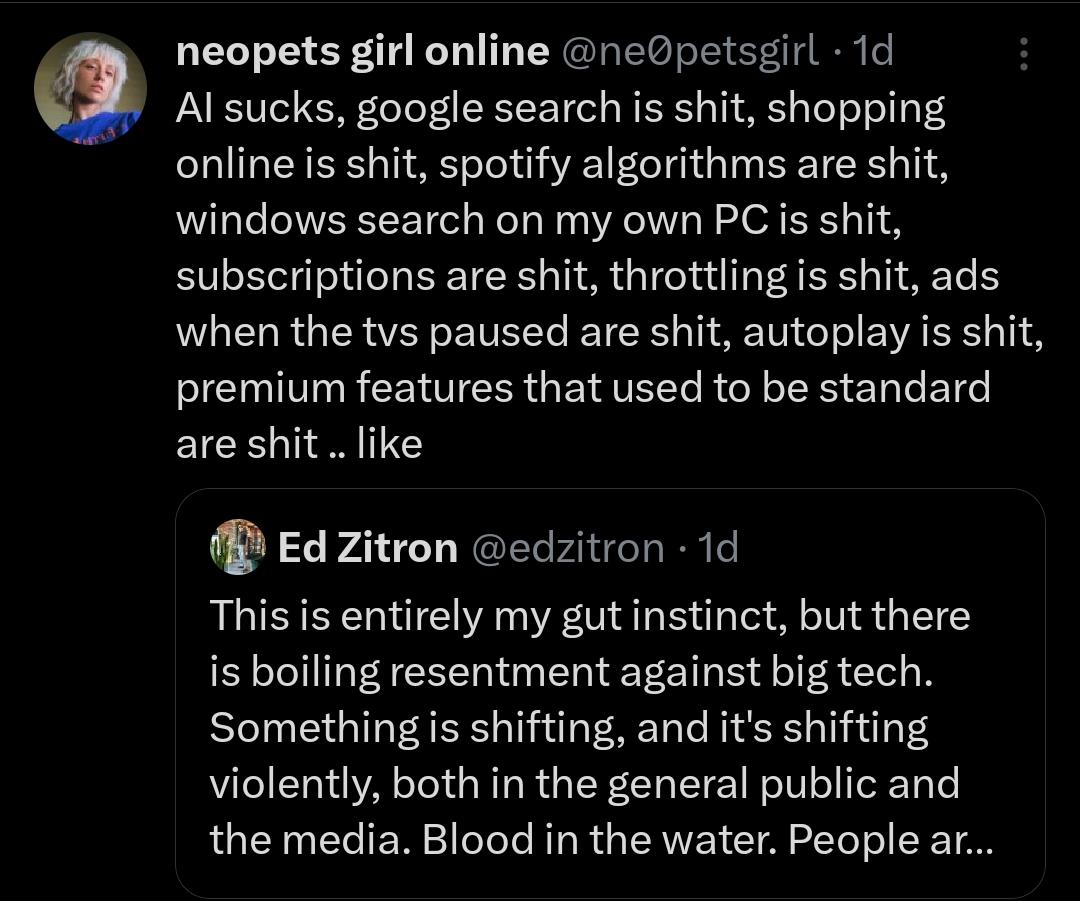
Partially, this general decline springs from s misalignment of incentives. To bring up the old saw again, all of these products and services relying on advertising for revenue means that you become the product. But it’s more than that, too. It’s what I call the “scam economy” taking shape. This goes well beyond Cory Doctorow’s1 “enshittification.”
The “scam economy” is the result of transition of the entire sociocultural basis of trade behavior from community-minded mutual service with some profit stacked on top to an attempt to grift everyone else at any opportunity. This is what our economy has slowly but nearly-fully moved to since the 1980s. Ads as the primary revenue model just reinforced this pre-existing trend, but did not create it. “Enshittification” is just a natural outcome of this larger movement.
I’ve been thinking about what the larger animus driving this transition to a scam-based economy might be, but I haven’t reached any solid conclusions yet. When I do I’m sure you’ll be the first to know.
Return To Sender
Well that’s an incredibly good way to get fired. Where I work, I could read anyone’s emails anytime I want but I do not because, first, it’s not ethical and is, as mentioned, a good way to get canned. And it’s boring to read other people’s emails even apart from all that. I have far and away enough of my own.
And in some cases, you can get tossed in jail for doing so. Why do that?
Guises and Disguises
Tech Layoffs Reach 132,000 8 Months Into 2024.
Very brutal out there this year. And as I’ve mentioned before, that doesn’t include all the de facto layoffs disguised as RTO. Also, there have been a lot of forced relocations. It’s probably going to get a bit worse too, at least in tech.
‘Had It
Can we go Butlerian Jihad yet or not? I think we should.
Prog Shock
Because I don’t want to monkey with the PHP that runs this site, I’m sort of using CSS as a full-ass programming language. And that’s been weird but kinda fun. I would never, ever (as mentioned) want to do it as a job, though.
But it’s been enough, despite the huge limitations of doing it that way.
Character 80
What was the first PC game you ever played? Mine was Microsoft Flight Simulator 1.0.
Not sure what counts as a PC here, but my first game was probably a ski game on the TRS-80 that had no graphics but was character-based. I don’t think that it’s any of the ones I can find on the internet, either. This would’ve been some time in 1980.
Before that, I played the original Pong console (which was of course not a PC).
SOC IT 2 Me
Oh fuck no that’s not reasonable. I have well more than 20 years of IT experience and I’m about to do this nearly solo at a much smaller org. I’m also fairly well-versed in compliance, and I can barely handle it1. It’s a huge task, with hundreds of interlocking parts necessitating deep understanding not just of IT but of the entire business and of various compliance requirements.
Someone with only six months of sysadmin experience going for SOC 2 is like sending out a gaggle of kittens to fight a rhinoceros. It’s just not gonna happen.
When I was working at a company of similar size to the OP’s, it took a team of about a dozen people working on it nearly full-time for 18 months to get SOC 2 Type II. I’d expect about the same anywhere.
Chat Chit
Meanwhile, Redditors will insist this is “impossible” 5 years after it becomes common.
Solving
Working at a non enterprise level is weird.
I’ve swapped back and forth from enterprise to smaller orgs over the years. And it is certainly odd to go from working with the largest companies on the planet planning networks that serve 60,000 people to a smaller place where a user base of 60 people is considered huge.
At the smaller place, you’ll still do some complex networking and other stuff1 but you’ll also be pulled into calls with three people who have tried and failed for half an hour to help a salesperson unmute her headphones. Or you’ll have to crawl under the desk to plug back in an Ethernet cable someone kicked out of the wall. And then five minutes later, jump on a call with the Federal Reserve (happened to me a few months ago when I went to a physical office for a few in-person meetings). Even if none of the above is your job, it becomes yours because you’re the only one who can solve things.
Cisgo
Cisco is cutting over 4,000 jobs for the second time this year.
Things are rough in the tech world. Glad I’m not having to look for a job right now. Nearly 300,000 people laid off in a year and a half, and even more than that not counted because RTO and other slimy methods were used to do stealth layoffs. So, say, 500K tech jobs lost in that time. That’s a helluva lot.