Uncontained

The main problem with containerization (which alas I’ve been using a lot of lately) as created by devs is that it only cares about one thing and that is: Can I transport a near-approximation of my machine somewhere else and run it?

Security? Who gives a fuck! Networking? I know what an IP address is, that’s all you need, right? Maintainability? Someone else’s job. Troubleshooting? Works on my machine, and now you have my machine!

It’s a terrible technology designed by the incurious, coded by the inept, and promoted by the incompetent. But we’re stuck with it now.

Done Wrong

TLS certificates for internal services done right.

Bro, if you’re using split horizon DNS — no matter how it’s set up — you’re not doing anything right.

I guarantee that you’ll have problems of all kinds there. Reachability, security (I already spotted at least three major issues!), and flaky-ass behavior left and right.

Split horizon DNS is the way of the pain. You think it won’t happen, but it will. Terrible idea.

Resp

That can’t be right. I spend like 1-2 days every 2-3 years sick with a respiratory infection. And that has been true my whole life, not just when I began working from home. In fact, I don’t know anyone who is sick that often from respiratory infections.

Before I posted this, I asked a close friend who will tell me absolutely anything honestly how often she gets sick and she said, “Maybe one or two days a year.”

I think that number is just made up by covert Covidians to support their doofy but now-irrelevant agenda.

Maison du Crack

Anyone who believes that is smoking ALL the crack. Below I will explain how you can lie in plain sight and get away with it unless someone has a giant fucking brain like I do.

First, this is based on own earnings, i.e., per individual. The enormous gap between Silent/Greatest gen and everyone else is mostly due to women entering the paid workforce. Half the Silent Gen “median person” was a non-earning or low-earning (almost always a woman) spouse. That means there are a bunch of non-earner zeros on the left side of their medians. That further means that their individual labor earnings crater, necessarily. That’s obviously not because a 1955 machinist was poor, but because the median adult then included millions of women with almost no recorded labor income. So that is just a simple composition effect they are using to lie there.

By the way, I’ve read the papers these charts are poorly cribbed from. One of them says the exact opposite of what’s presented here in fact. Check it yourself. There’s a reason it’s called (in part) “Has Intergenerational Progress Stalled?” Why each generation earns more is largely based on the fact that each generation works more because there are more of the pool in the labor force.

Another major deception here: the inset chart series is post-tax, post-transfer. Thus, it imputes the market value of public health insurance (Medicare/Medicaid) at the cost of providing it. Healthcare costs exploded during the past 50 years. National health expenditures per capita rose ~3.5% per year in real terms. Because those costs are booked as income to the recipient, rising medical prices mechanically show up as you getting “richer.” Which is, you know, fucking ridiculous. But a good way to lie for econs. They do it all the time.

Another one: The big chart uses CPI (in 2019 dollars) while the paper uses PCE. Pew just recently showed real median wage growth since 1999 lands at anywhere from 11% to 22% depending just on which inflation index you choose. Those clowns chose the measure that made their point look the most rosy. Also, of course, during that time, housing and education outran inflation by a lot. A single economy-wide deflator averages a representative consumer’s basket. It is really fucking not the basket of a 26-year-old, which is dominated by rent, first-time home prices, tuition, childcare, and medical, which are the exact categories that rose way out of proportion to general inflation.

And, lastly, Gen Z is the least trustworthy part of that whole set of absurd lies data-wise. More of Gen Z is still in school and for longer, so the ones with recorded earnings at 20โ€“24 are a selected slice of the population. Often, it’s those with parental help, nepo babies, athletes and otherwise-abnormal people that skew the stats a lot.

In other words, these are shoddy lies that nevertheless will hoodwink most. You can fool most of the people most of the time with crap like this, but me nearly none of the time.

Nice try, though. I had to spend three entire minutes thinking about it, which is two more than usual.


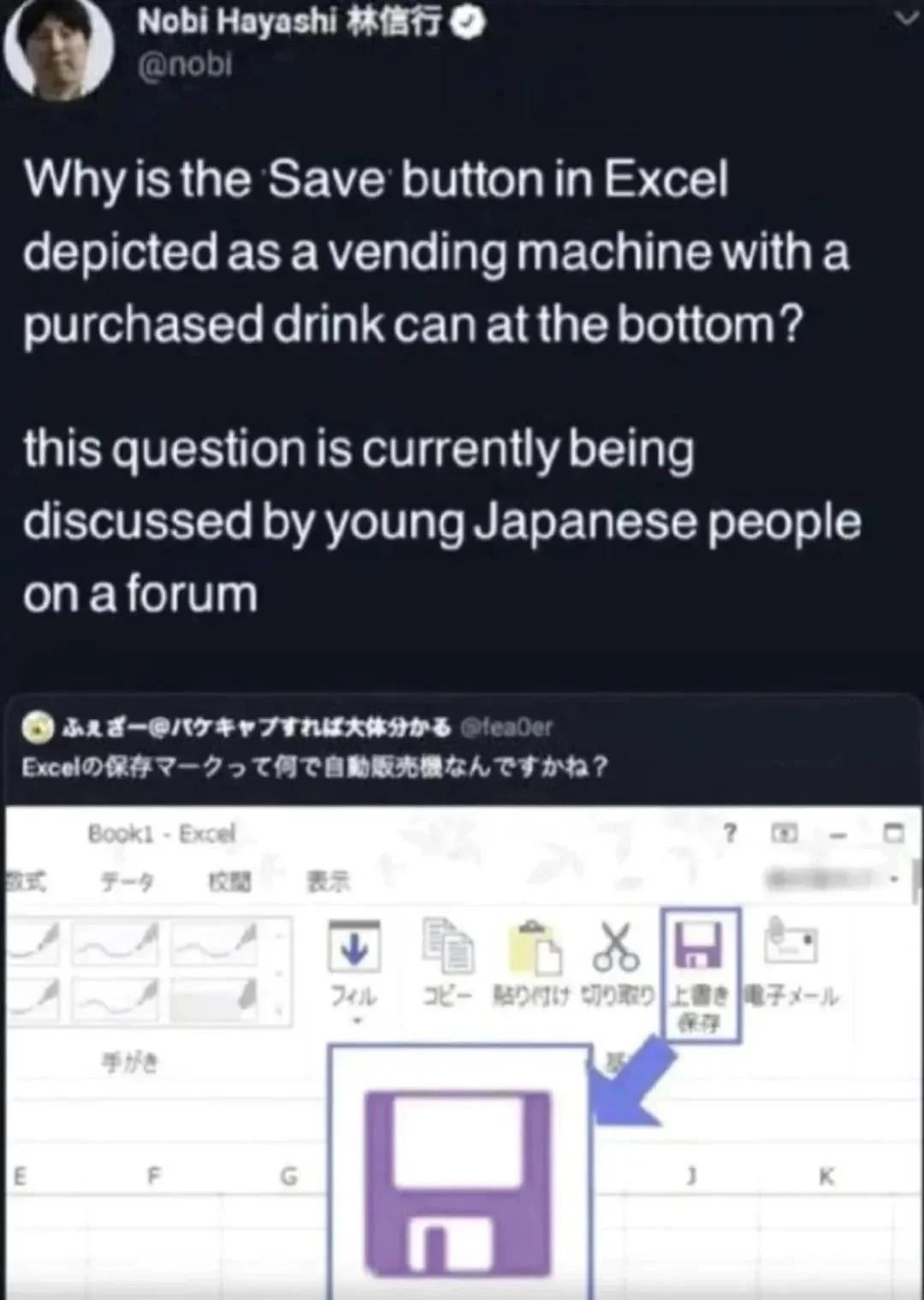
Put Folder

I ws looking at Navidrome for personal music streaming but then saw this.

That’s a dealbreaker. This software is written by younger Millennials and Gen Z who don’t know what a fucking directory is. Despite their clownish ignorance a folder structure is the best way to handle a lot of data and probably always will be. Not all music is tagged or tagged accurately. Putting it in a damn folder is the quick and dirty way to organize it easily.

You know tons of people have asked for it if they put disclaimers all over the place about why they won’t do it. Because they are fucking idiots. I logged into GitHub to complain about it to them. I know it won’t help, but it made me feel better.

Backxactly Ackwards

Castro Podcasts โ€” Things I got wrong: Support.

Castro is an opinionated app and Iโ€™ve thought a lot about what weโ€™re building and what weโ€™re going to work on next. Itโ€™s unlikely Iโ€™m going to implement the request. If I did, by catering more to persnickety power users, we run the risk of alienating newer users who donโ€™t know how things work. But our power users probably arenโ€™t going anywhere, at least theyโ€™re a little harder to shake, and alienating new users is the death of the product.

This is exactly backwards. But I think the piece accidentally reveals a fundamental misunderstanding that is very common to people who create software. The reality is that your power users are the ones who funnel new users to to you. Firefox never would’ve taken off without its power users; I personally got hundreds of people to use Firefox, many of whom never would’ve heard of it at all without my influence.

When they decided to kick their power users in the teeth for largely made-up post-hoc manufactured bullshit reasons is when that software began its long usage decline. The Mozilla clowns blame the power users (at least in part) for this, but in reality it’s those users who told them what would happen if they made the bad decisions they did. And they were right, as I’ve pointed out before.

Dustin’s counterproductive reaction — as it almost always is — is a power and pride thing. Power users are often completely correct about what would make your product better for everyone. But that rubs many creators the wrong way because it means more work, and someone else having at least some measure of de facto control, and that someone saw something that you did not. It means the software becomes less yours if you let someone tell you what would in fact work better for them. And many people (such as the Firefox devs) just enjoy having control over others.

I have nearly no idea what Castro is or what it does. It seems to be about podcasts, which means I’d never touch it. But Dustin’s contentions really misunderstand what power users offer in a software ecosystem, and what it means to alienate them.

For instance, I can tell that I’d never use Castro at all even if I were into podcasts because any creator who makes a point to shit on power users is one whose product I’d not even consider in the first place.

Where To Strike

TrueNAS is tons faster than the Synology — partly due to that it’s just on much newer, quicker hardware — but in many ways it’s amateur hour. And I want to punch whoever thought it should be so locked down right in the chigooblies. This isn’t consumer-class infra. Gramma is not going to send her money to Nigeria if you don’t prevent me from monitoring fans. And all because I don’t have a BMC?

Yeah, fuck you, buddy.

I don’t know that there is anything better than TrueNAS, alas. But it is free, and that’s something.

Too Tat

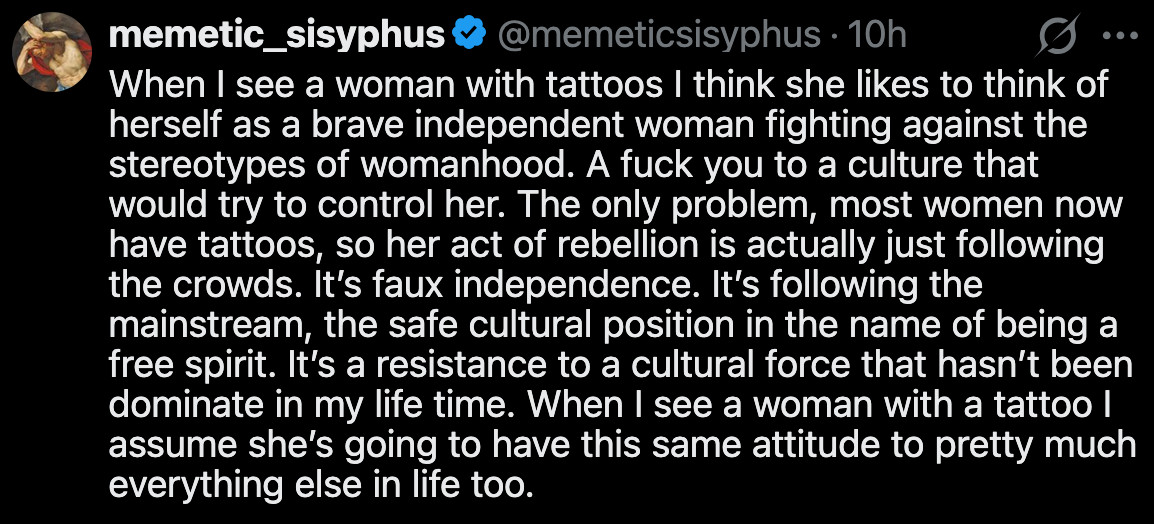
(1) memetic_sisyphus (@memeticsisyphus) / X

Correct. It’s also culturally-defensible (and defended) self-harm in a way that cutting and anorexia are not. It’s just mental illness; has nothing to do with the claimed “owning my body” or “keeping away evil men.”

Though it is pretty hilarious when it does in fact repel those top 1% men they think they deserve. Love that. It makes me laugh a lot at how very enraged the horribly-disfigured tattooed women become when they realize that has happened.

The Nincompoops Who Say NIH

Containers, especially the Linux (as opposed to the FreeBSD) variant, are inherently less secure by nature than virtual machines.

Also, FYI, we sysadmin types can spin up VMs just as quickly as containers and have been able to do so for 20+ years. It’s just devs didn’t know anything about it and couldn’t control it, so they reinvented something we could already do — but poorly and very insecurely.

Veeam Fail

For the first time an LLM — Claude Opus 4.8 on High — solved a technical problem I would’ve never been able to solve. At least not in a reasonable amount of time. And I’m very, very good.

The problem manifested as I was installing Veeam Community Edition on an air-gapped Hyper-V server. The installer kept complaining it could not continue because it was unable find/validate certificates. So I researched and (get this) from the vendor’s own site I downloaded the missing certificates they claimed were needed. Installed them in the correct place in Windows Server. The Veeam install still failed after that.

As happens all too often, their own support page was incorrect and the certificate actually needed was not the one they had you download. Again, vendor’s own site, vendor’s own support pages. Totally incorrect.

Here is Claude’s summary of what was wrong and the fix:

The certificate was in the box the whole time

Air-gapped a Windows box, then tried to install Veeam Community Edition. It refused with an Authenticode error: CERT_E_CHAINING, “a certificate chain could not be built to a trusted root authority.”

The cause is what air-gapping actually does. A connected Windows box doesn’t ship knowing every root it trusts; it fetches missing intermediates on demand and refreshes its trusted roots from Microsoft in the background. Cut the wire and both stop silently. The trust store just freezes at install-day state and starts declining signatures without telling you why.

I chased the roots first, including the ones Veeam lists on their own site. No luck: Veeam moved their code signing to an Entrust EV cert and never updated the page, so the root their installer needs isn’t on the list of roots they tell you to install.

The fix was to stop trusting the documentation and read the binary. An Authenticode signature embeds its own certificate chain, roots included โ€” two here, one for the signature (Entrust) and one for the timestamp (DigiCert), each anchored to a root the air-gapped box had never seen. Pull them out of the file, drop them in the machine’s root store, done. No internet, no vendor KB.

The machine had everything it needed to verify that installer. It just wanted to phone a friend first, and I’d taken the phone away.”

More fake bullshit-ass security causing endless problems that makes you 0% more secure. Just clownish dipshittery. Veeam used to be good.