
That’s what should happen. But it won’t.
That’s what should happen. But it won’t.
It’s AI. My company has canceled at least one hire due to no longer needing the role since AI is doing 100% of the job.
And that’s how it’ll happen. Despite flashy layoffs (Oracle, Microsoft), most of the results of AI will be people who are not hired: junior and even mid-level people in various tech fields just aren’t obligatory to bring on board any longer. And that is only going to get worse.
So, in other words, the problem is not and won’t be firing. It’ll be lack of hiring.
And yes, this will soon happen to other fields1, as it always does. As usual, tech just gets hit first.
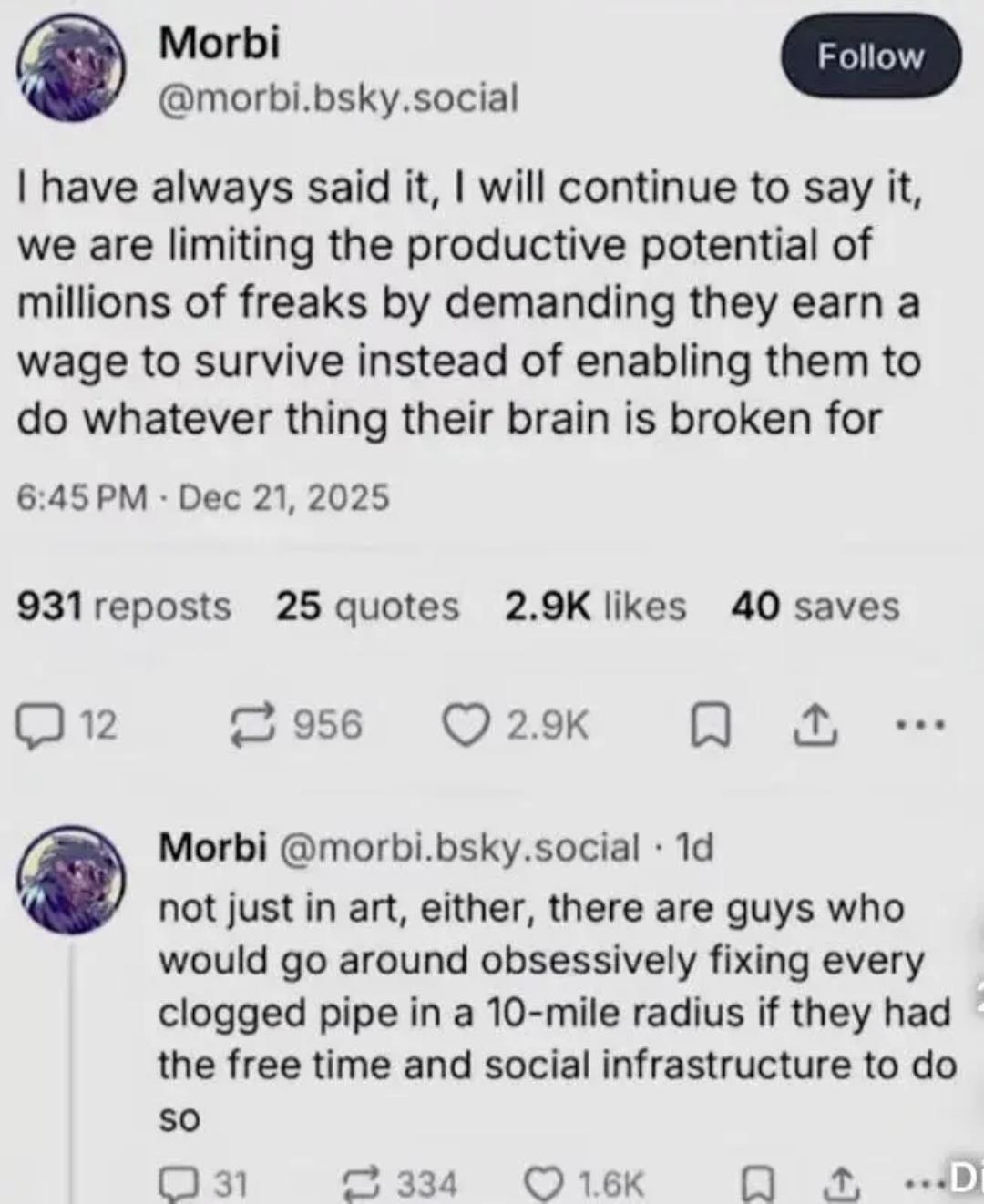
I think there’s something to this. Hell, my dad would’ve probably fixed every lawn mower in a 50 mile radius if someone would’ve paid him enough to do it. He just liked that sort of thing, and was incredibly good at it.
But certainly, a lot less art gets produced of quality now becuase housing prices are too high everywhere to be able to survive on part-time waitress and grocery stocker.
If economics were a more honest profession, we could do a lot more to shelter people and the economy from the now-inevitable negative effects of AI. But it’s not so we won’t.

It’s happening. And as I mentioned below economists will lie to you about that it will happen, lie to you while it’s occurring, and then for good measure lie to you after it’s done tossing you and everyone you know into the street.
It’s what they do because it’s exactly what they are paid to do.
As usual, the economists are all lying about AI job loss. They assert that it won’t occur. The reality is that it’s already occurring but it is going to get so much worse.
Remember, these are the same econs who claimed NAFTA and MFN for China would have no negative effects, and then gaslit us for more than two decades that the “equivalent” job someone found as a Wal-Mart greeter was just as good as the unionized $40-an-hour factory role. That is, of those who found any job and just didn’t kill themselves with alcohol and opiates.
The heartland was eviscerated and we were told it did not happen, and if it did, it was good thing.
The same thing is occurring again but what will be eliminated this time are millions of white collar jobs. And contrary to econ fairy tales, nothing will replace them. It’s inevitable at this point.
The Grand Illusion: The U.S.-Europe Growth Gap.
So claim Ackerman and Baker.
But this contention is wrong. It is a bad paper and a flawed piece. First, since the GFC, a lot of people who got it right then seem to have gone absolutely nuts since. Ian Welsh, Dean Baker, Paul Krugman, to some extent Barry Ritholtz, and others. They just diverged from any sort of wisdom or probity. Not sure why but they have but it’s a real phenomenon.
This piece and the associated paper is a good example.
The primary mistake the Baker piece and the paper make is that it confuses level comparisons with growth comparisons and then frames that as an issue. However, current-PPP is for comparing countries in the same year, while constant/chained is for comparing real output across countries over time. You can’t just mix them up like that. I mean, you can I guess, if you want to look like a dumbass.
In other words, current-price series use each year’s prices, while constant-price series are used to measure true volume growth. That’s not any sort of contradiction, as the paper that Baker is discussing claims. That’s how they fucking work. FUCK.
There are numerous other bits of clownery like that, but the basic mistake dooms the paper from the get-go.
Now that I’ve toasted that POS paper, I’ll work on the not-quite-as-moronic Krugman claim.
So, Krugie, you mean to tell me that very large states with a high concentration of tech have higher productivity growth? OMG SO SHOCKING.
BLS says that California represents 14% of national output and ~20% of US productivity growth. Meanwhile, Washington state actually had the highest productivity growth 2007-2024, not California. It’s just a lot smaller.
The other problem with the Krugman boo-shit is conceptual. Composition effects are real economic effects, and are not artificial, nor are they a measurement issue. If the US has more highly productive digital clusters, that is part of US performance in toto and can’t just be broken off as some “fake area.” It’s all one country, baby, no matter if Dog Turd, Mississippi, isn’t benefiting much quite yet from what is happening in California (or Washington).
So much failure and clownery from people who should be smarter.

They probably aren’t going to get hired. Not only do people not realize what is about to happen, they deny it’s already happening.
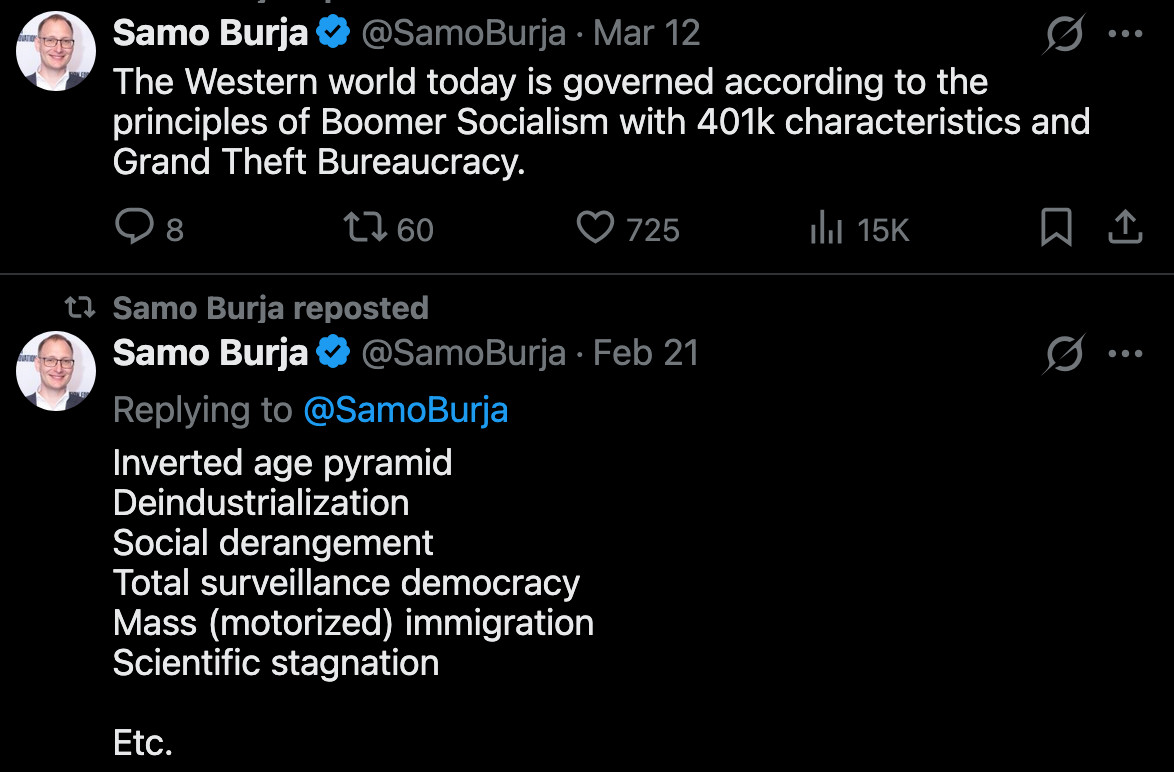
Correct. Basically everything is set up either to directly benefit Boomers or to not inconvenience them. And it is somehow getting worse, even as they age and die off, and not better.
The Strait of Hormuz being closed is not nothing, but not really the big deal that people are making it out to be. It would’ve been 40 years ago, but the world is different now.
Mostly, it’ll impact China and a few other Asian economies. Not so much anyone else.
ATMs didn’t kill bank teller jobs, but the iPhone did.

The comment in the screenshot is about my take on what AI will actually do to jobs and the economy; nothing else makes any sort of sense, regardless of economists’ lying about it all.
I don’t even disagree with this, but people like this never write such impassioned screeds arguing against wage theft, which takes more money out of the real economy.
Best estimate for wage theft (conservative assumptions:) $15 billion per year
Shoplifting (does not include organized crime retail theft): $13 billion per year
I’d argue that wage theft is more destructive than shoplifting, because not only does it most often impact the least able to afford it and battle against it, it normalizes patterns of exploitation that then persist throughout the economy.
When these people start standing against wage theft, I’ll be more likely to care what they think.
It does appear that what the liberals assured us all “would not happen” is happening: a fairly hostile tax regime leading to business departures from California. This is not a good thing.
That image looks AI-generated, but yes, the state of design in the US is appalling. And no, it isn’t due to cost (directly). It’s due to choosing. Overall, the cost of far superior and more human-centered design would only be about 10% more. Amortized over the length of a mortgage, in most places that’d be about $50 a month.
Paying $50 a month more to live in something that doesn’t look like a second-rate horse barn would be worth it to most people.

Zeynep is wrong and mostly so is Ernie. Most of the bust is due to AI. It’s early stages, but that’s the cause. The post-Covid hiring boom was mostly cleared out by the beginning of 2024. There was a lacuna, then AI-related job losses (in tech, but other areas too) started in mid-2025 and are increasing all the time.
Most people can’t even see the past, much less the present or the future. A bit disappointing from Zeynep, really.