Aquatic ape

This is why I always denigrate the Fat Acceptance movement.
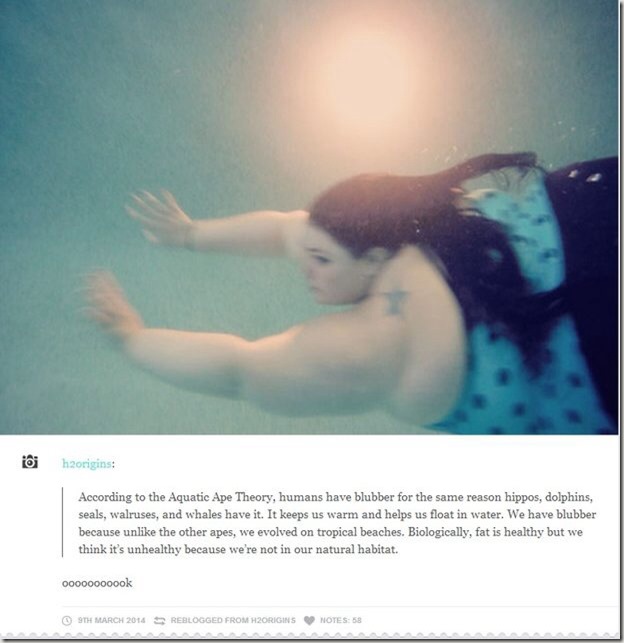
baMUfys

That is some deeply whacky bullshit. And almost certainly not a troll.

The Aquatic Ape theory is my favorite absolutely wrong theory. However, even if true, we wouldโ€™ve evolved our aqua-simian (kind of like Aqua Man, but apier) features where temperatures are warm so our blubber requirements would be minimal.

And gah, the stupid, the stupid, it burns.

0 thoughts on “Aquatic ape

  1. It’s so tragic how deeply misunderstood this idea generally still is. It’s NOT arguing for an ape origin in recent human evolution, that would’ve included these apes swimming in the open seas 24-7-365, like some sort of dolphin ape; that would indeed be complete nonsense. But AAH doesn’t argue that and never has. It simply suggests, that our features that seperates us from our ape cousins, furlessness, bipedalism, large brain, speech, hooded nose, etc., is best explained by us having evolved to be partially aquatic at the shorelines of Africa. That we’re an old beach ape. That’s all it posits. How that is crazy, I’ve never been able to fathom. It’d be nice if people would read the sources to something, before they get a cheap laugh at its expense. It doesn’t seem to matter to people what it’s actually talking about.

    • If the aspersions are being cast my direction rather than at the FA movement apologist above, I understand the AAH theory I just find it really implausible. The AAH is concise, elegant and probably wrong.

      Almost all its explanations can be better accounted for by increasing human tendency to neoteny in our evolutionary past (continuing even today), sexual selection and similar.

      But hey, what do I know? It’s not like I or anyone else was there in the past to truly chronicle it. But at least the tendency to neoteny shows up in the fossil record.

  2. There are still a lot of misunderstandings about our semi-aquatic evolution (so-called AAT): it didn’t happen 6 or more mill.yrs ago as Elaine Morgan thought, it has nothing to do with apes or australopithecines, but it’s about archaic Homo during the Ice Ages, e.g. most Homo erectus fossils are typically found amid edible shellfish (including marine) and show unmistakable convergences to littoral (coastal) species: very heavy skeletons, flat skulls, ear canal bony outgrowths, intercontinental dispersal, projecting nostrils, poor sense of smell, small mouth etc. Their lifestyle included shallow diving (e.g. for shellfish) when they followed the coasts at least as far as the coastal fossil or archeological sites of Flores, the Cape & Pakefield. This has been called the “coastal dispersal” model by Stephen Munro (2010), a better term than “aquatic ape” (see references below). All fossil, paleo-environmental, physiological etc.data show that human ancestors during the Ice Ages (Pleistocene Homo) did not run over open plains (sweating water + salt, both scarce in savannas) as often assumed in outdated views on human evolution, but simply followed the African & Eurasian coasts & rivers, beach-combing, diving & wading bipedally for littoral, shallow aquatic & waterside foods. This “littoral dispersal model” (Munro 2010) is corroborated by a lot of recent papers, e.g.
    -J.Joordens, S.Munro cs 2014 Homo erectus at Trinil on Java used shells for tool production and engraving, Nature doi 10.1038/nature13962
    -M.Verhaegen, S.Munro 2011 Pachyosteosclerosis suggests archaic Homo frequently collected sessile littoral foods, HOMO J.compar.hum.Biol.62:237-247
    -S.Munro 2010 Molluscs as ecological indicators in palaeoanthropological contexts, PhD thesis Univ.Canberra
    -J.Joordens cs 2009 Relevance of aquatic environments for hominins: a case study from Trinil (Java, Indonesia), J.hum.Evol.57:656-671
    -M.Gutierrez cs 2001 Exploitation dโ€™un grand cรฉtacรฉ au Palรฉolithique ancien: le site de Dungo V ร  Baia Farta (Benguela, Angola), Compt.Rend.Acad.Sci.332:357-362
    -K.Choi, D.Driwantoro 2007 Shell tool use by early members of Homo erectus in Sangiran, central Java, Indonesia: cut mark evidence, J.archaeol.Sci.34:48-58
    -S.Cunnane 2005 Survival of the fattest: the key to human brain evolution, World Scient.Publ.Comp.
    -M.Vaneechoutte cs eds 2011 Was Man more aquatic in the past? eBook Bentham Sci.Publ.
    -P.Rhys Evans cs eds 2013-2014 Human Evolution conference London May 2013 proceedings, special editions Hum.Evol.28 & 29
    -M.Verhaegen 2013 The aquatic ape evolves: common misconceptions and unproven assumptions about the so-called Aquatic Ape Hypothesis, Hum.Evol.28:237-266, google: researchGate marc verhaegen, or independent academia edu/marcverhaegen

  3. The recent genetic findings regarding the Basque origins of modern Britons – in which the Basque region denizens followed the coastlines of Spain and France which were connected to the British “Isles” – seems to me consistent with the idea that ancient people in general would follow food rich coastlines when migrating.

    • Yes, Homo has always followed the watersides. Early-Pleistocene archaic Homo already followed the African & Eurasian coasts when they dispersed intercontinentally, eventually even reaching islands far overseas: Flores, Sulawesi, Cyprus, Crete & the Dodekanesos. From the coasts they gradually also ventured inland along rivers & wetlands. All Neanderthals were riverside (river valleys, oxbow lakes, reed & beaver ponds) or else coastal (e.g. all northern Mediterranean coasts): most likely they seasonally followed the rivers to the sea every year (cf anadrommous spp such as salmon?). Their diet included shellfish, stranded seals & whales, fish, waterside carcasses of herbivores, aquatic & waterside plants: cattails, shallow water grasses (rice), waternuts, waterlily roots etc. (e.g. traces on their tools in their dental plaque). Google: Verhaegen Munro.

Leave a Reply

Your email address will not be published. Required fields are marked *